

 Mystery plots in interactive stories are constructed around a layered framework of suspects, clues, red herrings, and narrative beats that make an investigation both solvable and gripping. Understanding how mystery game plots are structured means recognizing that every element serves a dual purpose: it advances the story and tests the player's deductive reasoning. The best mystery designs use the "three-clue rule," controlled sandbox mechanics, and carefully timed plot twists to keep investigators engaged from the opening scene to the final confrontation. Whether you are writing a tabletop scenario, a digital investigation, or a cinematic interactive story like Murder in Prague, these structural principles are the foundation of every satisfying mystery.
What are the core components of mystery game plot structure?
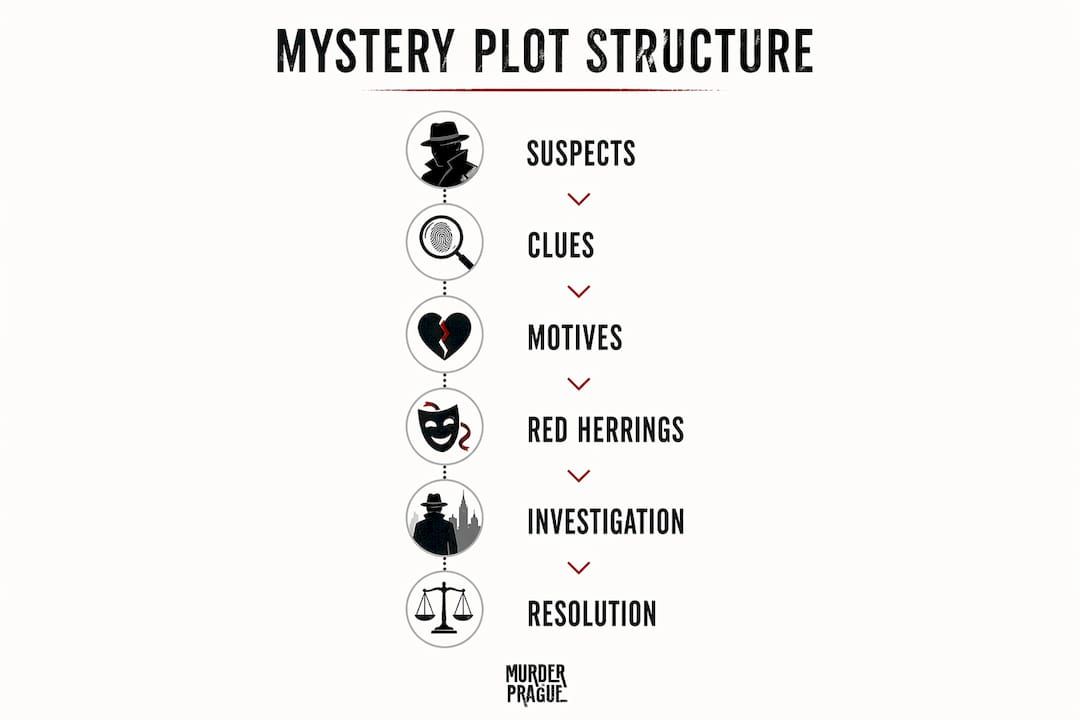
A well-built mystery plot rests on four interlocking elements: suspects, clues, motives, and red herrings. Each one plays a specific role, and none works in isolation.
Standard mystery design uses 4–6 suspects, each carrying a plausible motive, opportunity, and means. That range is deliberate. Fewer than four suspects makes the solution too obvious. More than six creates cognitive overload that kills momentum. Each suspect also needs a "secret life," a hidden detail that explains suspicious behavior without making them the killer. This keeps investigators second-guessing without feeling cheated.

Red herrings follow the same logic. Two to three well-placed red herrings deepen the investigation without blocking progress. A red herring should feel like a genuine lead until a later clue reframes it. The key distinction: a red herring misleads, but it never contradicts established facts. If it does, players feel manipulated rather than challenged.
The three-clue rule is the structural backbone of solvability. Every essential fact must be discoverable through at least three distinct, mandatory paths. That means one social clue (a witness or NPC conversation), one physical clue (an object or forensic detail), and one systemic clue (a record, timeline, or location-based trigger). This redundancy prevents dead ends and ensures that players who miss one path can still reach the truth.

Pro Tip: Write each suspect's alibi before you write their guilt. If an innocent suspect's alibi holds up under every investigative method, your mystery has structural integrity.
How do interactive mystery structures balance player freedom and narrative control?
The best mystery structures operate as controlled sandboxes, giving investigators the freedom to pursue leads in any order while keeping the solution space bounded and fair. This is the hardest design balance to achieve, and most failures fall into one of two traps: hand-holding that removes agency, or open-ended chaos that leaves players without direction.
A controlled sandbox works through four design principles:
- Clue distribution across locations. Spread physical, social, and systemic clues across multiple scenes so investigators naturally visit different areas. No single location should hold all the answers.
- Multiple valid investigative routes. Two investigators should be able to reach the same conclusion through different evidence chains. One might follow financial records; another might follow witness testimony. Both paths converge on the same truth.
- Verification mechanics. Verification acts as a safety valve that prevents false arrests and premature conclusions. Players should be able to check alibis, reconstruct timelines, test physical constraints, and cross-reference records before committing to an accusation.
- Paced information release. Withhold the most damning clue until investigators have built a partial theory. Revealing it too early collapses the tension. Revealing it too late frustrates players who have already stalled.
The middle ground between guided and open-ended investigation is what designers call the "structured discovery" model. Players feel they are uncovering the story through their own deduction, but the designer has quietly ensured that every essential fact is accessible from multiple angles.
Pro Tip: Map your clue distribution on a grid before writing any dialogue. List every essential fact on one axis and every discovery method on the other. Every fact should have at least three checkmarks.
What is the role of clues and information layering in successful mystery experiences?
Clues are the backbone of player experience. They prevent random guessing and make every discovery feel earned. A mystery without layered clues is just a coin flip dressed up in atmosphere.
Clue layering means building multiple levels of meaning into a single piece of evidence. A bloodstained letter is a physical clue at the surface level. The handwriting on that letter is a social clue pointing to a specific suspect. The postmark date on the envelope is a systemic clue that breaks a suspect's alibi. One object, three investigative vectors.
The most effective clue formats for interactive mystery stories include:
- Physical evidence: Objects, documents, photographs, and forensic details that investigators can hold or examine directly.
- Social clues: Witness statements, NPC reactions, and behavioral inconsistencies that emerge through conversation.
- Systemic clues: Bank records, phone logs, surveillance footage, and timelines that require cross-referencing to interpret.
- Narrative clues: Story beats delivered through cinematic scenes or character monologues that blend plot and hint seamlessly.
Narrative clues deserve special attention. Narrative clues delivered through story elements increase immersion because they feel like story, not puzzle. A suspect's offhand comment about a vacation they never took is both character development and a contradiction waiting to be caught. This is the technique that separates atmospheric mysteries from mechanical ones.
Internal consistency in clue logic is non-negotiable. If a clue points to a specific conclusion in chapter two, it cannot contradict a clue in chapter four without explanation. Inconsistency destroys player trust faster than any other design flaw.
Pro Tip: Assign each clue a "discovery tier." Tier one clues are unmissable. Tier two clues reward thorough investigation. Tier three clues are for players who go deep. Every essential fact needs at least one tier-one clue.
How do suspense and plot twists enhance mystery game storytelling?
Suspense in mystery storytelling is structural, not accidental. Mystery sessions follow three phases: setting the stage, investigation, and resolution. Each phase has a distinct emotional register, and the transition between them is where suspense lives.
The opening phase establishes the crime, introduces suspects, and plants the first clues. The investigation phase builds tension through accumulating evidence and narrowing suspects. The resolution phase delivers the confrontation, where investigators test their conclusions against the full weight of the evidence. Final twists and conspiracies belong in the confrontation phase, where they heighten drama without undermining the investigation that preceded them.
Plot twists work when they recontextualize existing evidence rather than introduce new facts. A twist that requires information the player never had access to feels like a cheat. A twist that makes the player reread every clue with fresh eyes feels like a revelation. The difference is entirely in the design of the clue architecture.
Mystery tropes are repeated narrative devices that communicate genre and mood instantly. The locked-room murder, the unreliable witness, the suspect with a hidden identity: these patterns set player expectations and create a shared investigative vocabulary. Subverting a trope lands harder than avoiding it entirely, because the player's expectation becomes the setup for the surprise.

Red herrings and suspect secrets fuel suspense across all three phases. A suspect who behaves guiltily for reasons unrelated to the crime creates genuine tension. When investigators finally uncover that secret, the relief of solving one mystery sharpens their focus on the real one.
Key Takeaways
Mystery plots succeed when suspects, clues, red herrings, and verification mechanics work together within a controlled sandbox that rewards deduction over guessing.

A cinematic mystery investigation worth experiencing firsthand
Understanding mystery plot structure is one thing. Experiencing it executed at the highest level is another.

Murder in Prague is a cinematic interactive investigation that puts you in the lead role of a detective thriller shot on location in Prague with an award-winning cast. You study authentic physical evidence alongside Netflix-level video scenes, hack into a victim's phone through a digital app, and cross-reference bank records while suspects call you directly. Every structural principle covered in this article is alive in the experience: layered clues, a cast of credible suspects, earned plot twists, and a pacing that builds genuine tension. It delivers escape-room-level immersion at home, for a fraction of the cost. Start your investigation and see how a masterfully structured mystery feels from the inside.
FAQ
What is the three-clue rule in mystery design?
The three-clue rule requires that every essential fact in a mystery be discoverable through at least three distinct paths. This prevents dead ends and ensures the investigation remains solvable regardless of which leads players pursue.
How many suspects should a mystery story have?
Standard mystery design uses 4–6 suspects, each with a plausible motive, opportunity, and means. This range keeps the investigation challenging without overwhelming investigators with too many competing theories.
What makes a plot twist feel earned rather than cheap?
A well-earned twist recontextualizes evidence the player already encountered rather than introducing new facts at the last moment. If investigators can look back and say "the clue was there," the twist lands as revelation rather than manipulation.
How does suspense work structurally in mystery stories?
Suspense builds across three phases: setting the stage, investigation, and resolution. Tension escalates as evidence accumulates and suspects narrow, with the confrontation phase delivering the highest-stakes moment where player conclusions are tested.
What types of clues work best in interactive mystery experiences?
The most effective clue types are physical evidence, social clues from NPC interactions, systemic clues like records and timelines, and narrative clues embedded in story scenes. Combining all four rewards investigators with different strengths and prevents any single discovery path from dominating.
Recommended