

Managing a large group mystery game means splitting participants into structured detective teams, designing a clear operational flow, and using active facilitation to keep everyone engaged from the first clue to the final reveal. The standard industry term for this format is "team-based mystery facilitation," and it applies whether you are hosting 20 friends in a living room or 150 colleagues at a corporate event. Standard mystery kits support 8–20 players, but groups beyond that threshold need a fundamentally different approach. Murder in Prague is one experience built with exactly that scale in mind, blending cinematic storytelling with physical evidence that works across multiple teams simultaneously.
What do you need to prepare before organizing a large group mystery game?
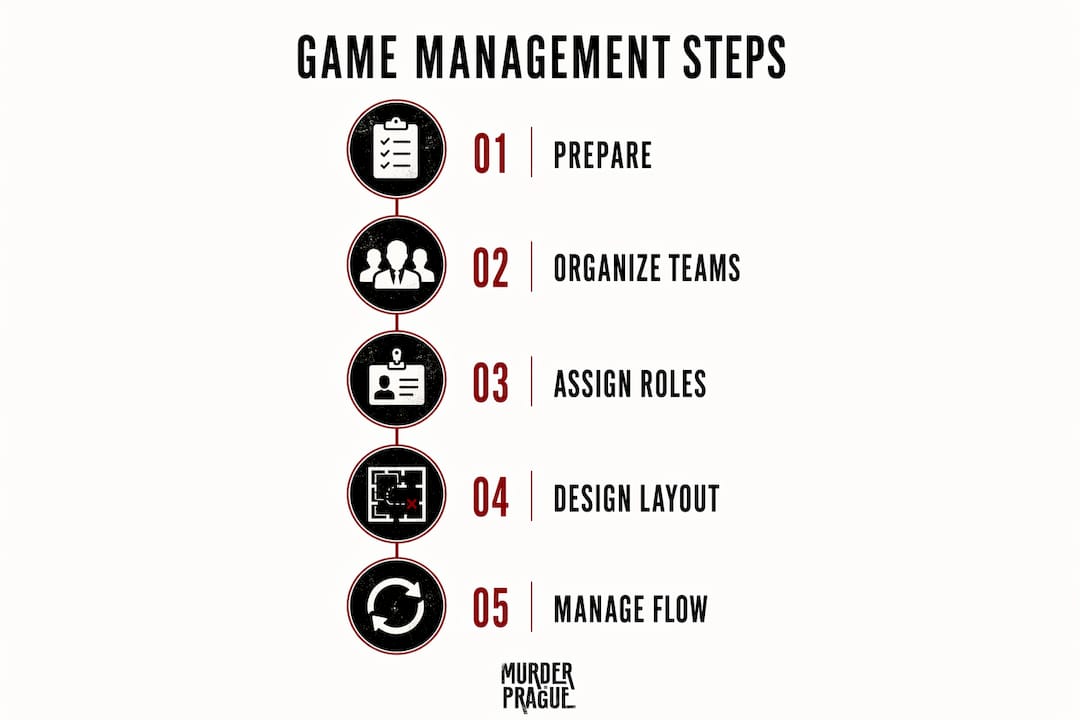
Preparation is the single biggest factor separating a smooth event from a chaotic one. Before anyone sits down to play, you need the right materials, the right space, and the right people running it.
Physical and digital kit requirements
Your mystery kit must support team-based play. A single set of clues shared across 30 people creates bottlenecks instantly. For groups over 15, plan for one complete clue packet per team of 4–6 players. Digital kits that distribute clues through an app are especially practical here, since they eliminate the risk of lost physical evidence and allow real-time updates. Apps that sequence clue release and allow real-time scoring improve fairness and keep every team on the same timeline.
Space and technology checklist
The right setup prevents confusion before the game even starts. Use this checklist to confirm you are ready:
- Dedicated team tables or zones: Each team needs its own physical or virtual space to discuss clues without overhearing other teams.
- Sound coverage: For in-person events, test that every corner of the room can hear announcements clearly. A single speaker at the front fails groups over 30.
- Breakout room capability: For virtual or hybrid events, virtual breakout rooms are essential for groups larger than 12–15 to prevent clue contamination.
- Backup supplies: Print duplicate clue packets, spare evidence sheets, and extra role cards. Redundant materials and dedicated facilitators are critical for smooth large-scale play.
- Dedicated facilitators: Assign at least one facilitator per 30–40 participants. They monitor team progress, answer questions, and keep energy high.
Pro Tip: Run a full tech check 30 minutes before guests arrive. Test your audio, your app login, and your breakout room assignments. A five-minute glitch at the start kills momentum that takes 20 minutes to rebuild.
How do you structure and organize teams in a large group mystery game?
Team structure is the architecture of your event. Get it right, and the game runs itself. Get it wrong, and you spend the night managing confusion instead of enjoying the story.
deal team size and why it matters
The ideal detective team size is 4–6 players. At that size, every person has a clear role, conversations stay focused, and no one sits quietly while two others dominate. For groups of 150 or more, professional corporate formats use teams of 8–10, but for social gatherings where personal engagement matters most, 4–6 keeps the energy personal and the collaboration genuine.

Groups over 15 players should always use a team-based format rather than individual roles. Individual role formats work beautifully for intimate dinners of 8–12, but they collapse under the weight of larger crowds. Too many characters, too many conversations, and too much noise.
Role assignments within each team
Assign specific roles inside each detective team to prevent one person from doing all the work:
- Lead Detective: Coordinates the team's theory and presents findings during reveal rounds.
- Evidence Manager: Keeps physical clues organized and tracks what has been examined.
- Note-Taker: Records observations, timelines, and suspect connections.
- Tech Operator: Manages the app, digital clues, or scoring platform if one is in use.
These roles do not need to be rigid. The point is to give every player a reason to stay engaged. When people have a job, they pay attention.
Pro Tip: Pre-assign teams before the event and send each player their role by text or email. Doing this on the night wastes 15 minutes and lets the energy drop before the game even begins.
What operational flow techniques keep large mystery events running smoothly?
Managing groups of 50 to 300 requires an operations-first mindset, focusing on how players move, how sound reaches every corner, and how transitions happen without confusion. The game content matters, but operational flow determines whether participants feel the story or feel the chaos.
Layout and movement design
Place team tables so every group has a clear sightline to the facilitator or screen. Avoid long rows where the back half of the room feels disconnected. A horseshoe or cluster layout works well for groups of 20–60. For larger events, divide the room into zones with a facilitator assigned to each zone.
Movement paths between stations need to be wide enough for groups to pass without bottlenecking. Mark paths with floor tape or signage if the venue is large. Dead zones, where players wander without direction, kill momentum faster than any technical glitch.
Timing and round structure
Use a numbered round system with clear time limits per round. A typical structure for a two-hour mystery event looks like this:
- Welcome and rules briefing (10 minutes): Clear, concise rule explanations at the start significantly improve participation and enthusiasm. Keep this tight and energetic.
- Round 1: Initial clue distribution (20 minutes): Teams receive their first evidence packet and begin building their case.
- Mid-game check-in (5 minutes): Facilitators circulate, answer questions, and release the next clue wave.
- Round 2: Suspect interrogation or video evidence (20 minutes): Teams analyze new material and refine their theories.
- Final deliberation (15 minutes): Teams lock in their verdict and prepare their presentation.
- Reveal and debrief (10 minutes): The solution is announced, and teams celebrate or commiserate.
Staggered starts and station rotations
Staggered starts, station rotations, and wave splits prevent bottlenecks and keep large groups engaged throughout the event. Instead of releasing all teams into the same clue station at once, stagger their start times by five minutes. This spreads foot traffic, reduces wait times, and keeps every station active without overcrowding.
Pro Tip: Use a visible countdown timer on a screen or whiteboard. When players can see time ticking, they self-manage their pace. You spend less time chasing slow teams and more time enjoying the event.
How do hosts handle common problems during large group mystery events?
Even the best-planned events hit friction. The host's ability to read the room and adapt in real time separates a memorable night from a frustrating one.
A well-prepared host who understands the technical tools and communicates clearly can make or break a large mystery event. Here is how to handle the most common problems:
- Stalled teams: If a team goes quiet or looks lost, a facilitator should approach within two minutes. Ask one targeted question rather than giving away the answer. "What do you know about the victim's last known location?" restarts thinking without spoiling the mystery.
- Lost or damaged clues: Always have duplicate packets sealed and ready. Hand the replacement over without fanfare. Making a big deal of it pulls everyone out of the story.
- Technical glitches: If an app crashes or a video fails to load, have a printed fallback version of the same content. Announce a two-minute break, fix the issue, and continue. Calm confidence from the host reassures the group.
- Energy dips: A mid-game energy dip is normal around the 45-minute mark. Counter it with a surprise clue drop, a short video clip, or a brief team-versus-team challenge. Novelty resets attention.
- Dominant players: Some participants take over their team's discussion. Facilitators can redirect by asking quieter members directly, "What do you think about this piece of evidence?" This keeps the experience inclusive.
Hosts who read energy levels and adapt pacing consistently deliver better outcomes than those who follow a rigid script.
What formats and ideas work best for large group mystery games?
The format you choose shapes the entire experience. Different group sizes, settings, and goals call for different structures.
Team detective challenge: The most common format for large gatherings. Teams of 4–6 work through the same mystery independently and compete to identify the killer first. This format scales from 20 to 200 players with minimal changes to the core game.
Station-based rotation: Teams move through a series of physical or virtual stations, each containing a different piece of evidence. This format works beautifully for venues with multiple rooms or for hybrid events where some players are remote. It also prevents any single team from hoarding clues.
Split-wave events: Large groups are divided into two or three waves that play the same mystery at staggered times. This reduces the operational complexity of managing 100 people simultaneously and allows facilitators to give each wave more personal attention.
Virtual and hybrid formats: Online mystery events use breakout rooms for team deliberation and a shared main room for clue reveals and announcements. Apps that distribute clues digitally and track team scoring in real time make virtual formats genuinely competitive and engaging.
Thematic variations: Adjust the mystery's setting and tone to fit your group. A film noir thriller suits adult gatherings and corporate events. A lighter, comedic mystery works well for family reunions or mixed-age groups. The theme does not change the operational structure, but it dramatically affects how invested players feel from the opening scene.
Key Takeaways
Successful large group mystery facilitation depends on team structure, operational flow, and active host management working together from the first minute.

What we have learned from running large mystery nights
The most common mistake hosts make is treating a large group mystery game like a scaled-up dinner party game. It is not. Once you cross 20 players, you are running an event, not a game night. That shift in mindset changes everything.
Preparation time should be at least double what you think you need. The logistics of printing clue packets, testing technology, briefing facilitators, and arranging the space take far longer than the game itself. We have seen beautifully designed mysteries fall flat because the host spent 45 minutes troubleshooting a projector while 40 people waited.
Keep the rules simple. The temptation with large groups is to add complexity to keep everyone busy. Resist it. Simple rules that every player understands in 90 seconds beat elaborate systems that require a 10-minute explanation. The story carries the engagement. The rules just need to stay out of the way.
The moments that linger after a large mystery event are never about the clues. They are about the arguments between teammates, the triumphant moment when someone cracks a key piece of evidence, and the collective groan when the killer is revealed. Your job as a host is to protect those moments by keeping the operational machinery invisible.
— Murder in Prague
Murder in Prague makes large group mystery nights easier
Planning a large mystery event takes real effort, and having the right kit underneath you makes a significant difference.
