


Effective note-taking during a mystery investigation is the practice of recording observations, reasoning, and evidence in real time, in a structured and secure way, to preserve accuracy throughout the entire investigative process. Professionals call this contemporaneous documentation, and it is the gold standard for any serious detective work. Whether you are playing a murder mystery game or running a full case analysis, your notes are your most reliable tool. Skipping this step, or doing it poorly, costs you clues, clarity, and credibility. Tools like Forensic Notes, Evernote, and Obsidian each bring something different to the table, and choosing the right one shapes how well your investigation holds together.
What are the foundational principles of note-taking during a mystery investigation?
Contemporaneous notes are records captured at the moment events occur, not reconstructed from memory hours later. Memory bias distorts recall quickly, and notes written after the fact reflect what you think happened rather than what you actually observed. This distinction matters enormously when you are trying to build a credible theory or defend your conclusions.
Every note you write should capture four types of content: your direct observations, your interpretive thoughts, the actions you took, and the reasoning behind each decision. Notes reflect methodology and decision-making, which is why vague entries like "checked the letter" are nearly useless. A stronger entry reads: "Checked the letter at 9:14 PM. Ink color inconsistent with the signature. Suggests possible forgery. Will cross-reference with the envelope postmark."
Timestamping every entry is non-negotiable. A timestamp anchors your note to a specific moment and prevents anyone, including yourself, from questioning when an observation was made. Avoid editing past entries. If you need to correct something, add a new dated note explaining the correction.
- Record the exact time and location of each observation
- Note what you saw, heard, or touched, not just your interpretation
- Capture your reasoning: why does this clue matter?
- Flag questions and inconsistencies as separate entries to revisit
- Never delete or overwrite an earlier note
Pro Tip: Apply the "Doberman approach" to every clue. Exhaustively extract every detail from a document or physical object before moving on. Ask who created it, when, why, and what it implies about other evidence in the case.
Which tools and methods best support effective note-taking in mystery investigations?
The right tool depends on how sensitive your notes are and how complex your investigation becomes. Evernote suits general note-taking, while Obsidian is preferred for sensitive investigation notes because it stores everything in local vaults and supports bidirectional linking between clues. For the highest integrity needs, cryptographically verified tools like Forensic Notes create tamper-proof records that qualify as self-authenticating evidence.

Digital tools beat paper notebooks in almost every investigative scenario. Digitizing note-taking improves integrity and oversight while enabling faster intelligence sharing across a team. Paper notes can be lost, damaged, or altered without any record of the change. A digital system with automatic backups and version history removes those risks entirely.
Cryptographic verification takes digital note-taking one step further. Timestamped digital notes with independent verification qualify under FRE Rule 902(14) as self-authenticating evidence. That standard matters even in recreational mystery investigations because it trains you to treat your notes as a credible record rather than a personal scratch pad.

Pro Tip: Organize your digital notes into case-specific folders from day one. Cross-reference each clue entry with at least one related note using tags or links. Graph-based note organization makes hidden connections visible in complex investigations.
How do you document and analyze clues and sources effectively?
Every document or physical clue you encounter carries five core attributes worth recording. Investigators should document the creator, purpose, intended audience, point of view, and investigative context fit for every source they analyze. Skipping any one of these leaves a gap that can mislead your entire theory.
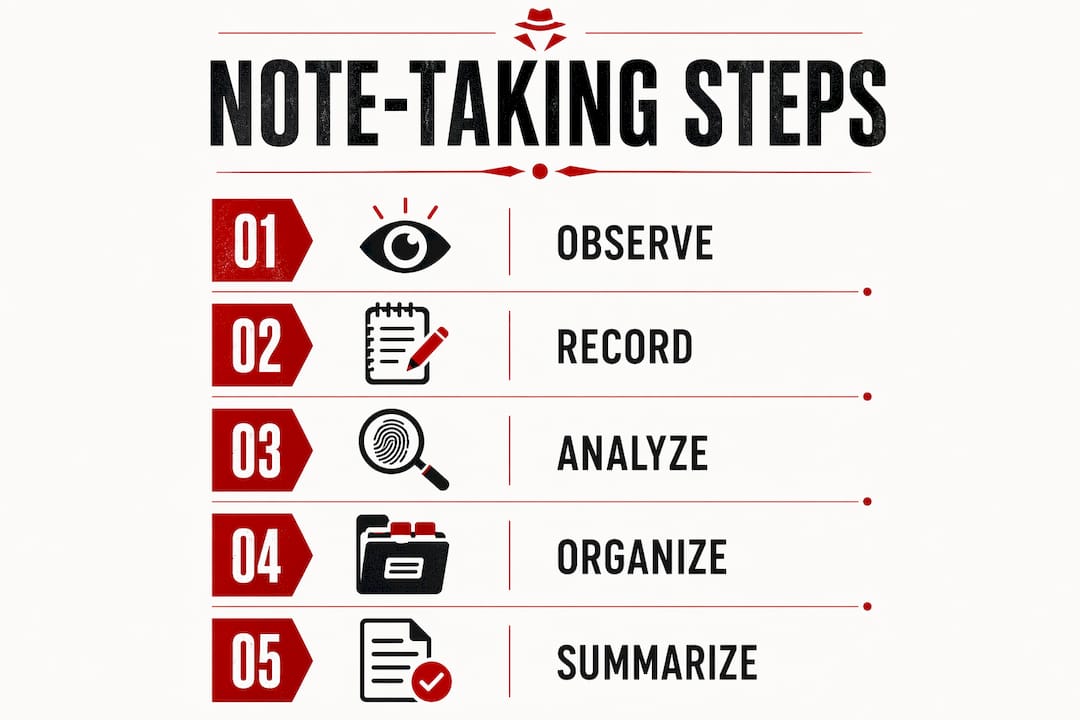
Physical and digital metadata reveal far more than the surface content of a clue. Ink types, PDF metadata fields like CreationDate and ModDate, and digital signatures all provide hidden evidence about when and how a document was created or altered. A letter dated in March but printed with ink that was not commercially available until June is a major red flag. Your notes should capture these anomalies explicitly.
Read every document fully before forming conclusions. Investigators who skim miss the footnote, the postscript, or the crossed-out word that changes everything. After reading, write a brief summary and list every question the document raises. Those questions become your next investigative leads.
Use these questions for every clue or document you encounter:
- Who created this, and what was their motive?
- When was it created, and does the date match other evidence?
- Is this an original or a copy? If a copy, where is the original?
- Who was the intended audience, and what does that reveal?
- What does this document imply about other people or events in the case?
- Are there any anomalies in format, language, or physical condition?
- What questions does this raise that I have not yet answered?
Documents that raise more questions than they answer are not dead ends. They are the most valuable leads in your investigation.
What are best practices for organizing notes during and after the investigation?
Chronological organization is the backbone of any well-run investigation. Keeping notes in time order preserves the narrative of how your understanding developed, which matters when you write a final report or explain your reasoning to others. A note from early in the investigation that seems minor often becomes critical once later clues appear.
Notes serve as primary references for reports and testimony months or years later. That means your organizational system needs to hold up long after the investigation ends. Tags, folders, and cross-reference links make retrieval fast and reliable. An unsorted pile of notes, even detailed ones, is nearly useless under time pressure.
After each investigation session, follow these steps to lock in your progress:
- Review every note from the session and flag unresolved questions
- Add tags to each entry: suspect name, location, clue type, or timeline position
- Write a one-paragraph session summary capturing your current theory
- Cross-reference new notes with earlier entries that connect to the same clue
- Back up your notes to a secondary location before closing the session
Generating summaries from raw notes is one of the most underrated investigation skills. A summary forces you to synthesize scattered observations into a coherent picture. That process often reveals connections you missed while writing individual entries.
What common mistakes do mystery investigators make when taking notes?
Delaying note-taking is the single most damaging mistake an investigator can make. Memory degrades within minutes of an event, and the details that disappear first are usually the most specific ones: exact wording, precise locations, the order in which things happened. Write it down immediately or accept that you will reconstruct rather than recall.
Insufficient detail is the second most common failure. Entries like "suspicious note found" tell you almost nothing when you return to them later. The note should read: "Found a folded note inside the blue envelope on the desk. Written in red ink. Unsigned. References a meeting at midnight on the 14th. Inconsistent handwriting in the last line."
- Delaying note-taking beyond a few minutes of an observation
- Recording conclusions without the observations that support them
- Using tools without backup systems, risking total data loss
- Letting notes pile up without organizing them between sessions
- Ignoring metadata cues that reveal document authenticity or timeline problems
- Overloading entries with raw data and never generating summaries
Pro Tip: Back up your digital notes at the end of every session with a verified timestamp. Relying on paper or disconnected systems increases the risk of losing critical evidence at the worst possible moment.
Key takeaways
The most effective way to take notes during a mystery investigation is to write contemporaneously, document every clue's five core attributes, use a digital tool matched to your security needs, and organize entries chronologically with cross-references after each session.

Why rigorous note-taking changed how we run investigations
We have run a lot of mystery investigations at Murder in Prague, and the single biggest shift in our approach came when we stopped treating notes as a memory aid and started treating them as the investigation itself. Early on, we would jot down a clue and move on. Later, we could not reconstruct why we thought a particular suspect was relevant, or which detail had pointed us toward a specific theory. The notes existed, but they were not doing any real work.
Switching to a structured digital workflow, specifically using Obsidian for its linking features, transformed how we connected evidence. Seeing a visual graph of how clues related to each other surfaced patterns we had completely missed in linear note form. The transition from paper to digital was awkward for the first few sessions. Old habits die hard, and reaching for a pen feels faster in the moment. But the retrieval speed and cross-referencing power of a well-organized digital system pays back that investment many times over.
The habit that made the biggest difference was writing a session summary at the end of every play-through. That single paragraph forced us to commit to a theory, which made the next session sharper and more focused. If you take nothing else from this article, take that: summarize after every session, every time.
— Murder in Prague
Put your note-taking skills to the test with
Murder in Prague
Reading about investigative note-taking is one thing. Practicing it under pressure, with real physical props, a ticking clock, and a gripping cinematic story, is where the skills actually develop.

Murder in Prague interactive-movie investigation gives you a full immersive case to work through, complete with authentic evidence, a digital app, and a storyline set against the atmospheric backdrop of Prague. Every clue demands the kind of careful documentation this article describes. With over 90% five-star ratings, the kit is built to challenge your analytical thinking and reward thorough, organized detective work. Visit Murder in Prague to explore the full range of mystery and start sharpening your investigative instincts today.
FAQ
What does contemporaneous note-taking mean in an investigation?
Contemporaneous note-taking means recording observations at the exact moment they occur rather than from memory later. This practice prevents memory bias and preserves the accuracy of your investigative record.
Which digital tool is best for mystery investigation notes?
Obsidian is the strongest choice for complex or sensitive investigations because it stores notes locally and supports graph-based linking between clues. Evernote works well for simpler, general-purpose documentation.
What questions do you ask when analyzing a clue or document?
Ask who created it, when, why, and for whom. Also ask whether it is an original or a copy, what anomalies it contains, and what new questions it raises about other evidence in the case.
How do you organize investigation notes effectively?
Keep notes in chronological order, use tags and folders to categorize by suspect or clue type, and write a short summary after each session. Cross-referencing related entries is the fastest way to spot hidden connections.
Why do investigators back up notes with verified timestamps?
Verified timestamps prove when a note was created and confirm it has not been altered since. This protects the credibility of your documentation and, in formal contexts, supports compliance with evidence standards like FRE Rule 902(14).