

 A self-paced mystery game is an interactive investigation experience where players solve clues, review evidence, and reach a conclusion entirely on their own schedule, with no live host required and no synchronized turns. Unlike traditional murder mystery parties or escape rooms, these games hand you a complete case file and let you work through it whenever and however you want. Formats range from printable dossiers and downloadable evidence bundles to interactive-movie investigation like that offered by Murder in Prague. The appeal is straightforward: you get the thrill of detective work without the pressure of a ticking clock or a room full of people waiting on you.
What is a self-paced mystery game, and how does it work?
A self-paced mystery game is defined as a solo or group investigation where progress is driven entirely by the player, not by a host or a timer. You receive a set of materials, typically evidence cards, suspect files, witness transcripts, and case reports, and you work through them at whatever pace fits your life. There are no rounds, no live facilitators, and no scheduled sessions to coordinate.
The core mechanic is active clue processing. Players analyze, interpret, and connect pieces of information rather than passively reading a story. That distinction matters: player actions drive the investigation, making the experience feel like real detective work rather than passive entertainment. You are not watching a mystery unfold. You are building the case yourself.

The industry term for this category is "interactive mystery game," though "self-paced" and "self-directed mystery game" are widely used to emphasize the scheduling freedom. Both terms describe the same format. Murder in Prague, for example, combines a physical evidence kit with a digital app so players can pause, resume, and revisit clues across multiple sessions without losing the thread of the story.
How do self-paced mystery games differ from other mystery formats?
Self-paced detective games occupy a distinct space between escape rooms, murder mystery dinner parties, and traditional board games. The differences come down to structure, pacing, and player role.
Murder mystery dinner parties rely on assigned roles and live performance. Escape rooms impose a hard time limit and typically require a group. Board games like Clue use a fixed ruleset that limits investigative freedom. Self-paced mystery games remove all three constraints.
The evidence structure is what sets them apart most clearly. A murder mystery case file is a self-contained investigation built around reviewing reports, photographs, and letters rather than acting out scenes. Players are analysts, not performers. That shift in role changes the entire feel of the experience, rewarding careful readers and logical thinkers over confident improvisers.
Self-paced games also differ from linear puzzle games. The best titles allow free clue exploration rather than bottlenecked, stepwise puzzle solving. You can chase a lead, hit a dead end, and circle back to a piece of evidence you overlooked earlier. That open structure produces a more natural investigative rhythm.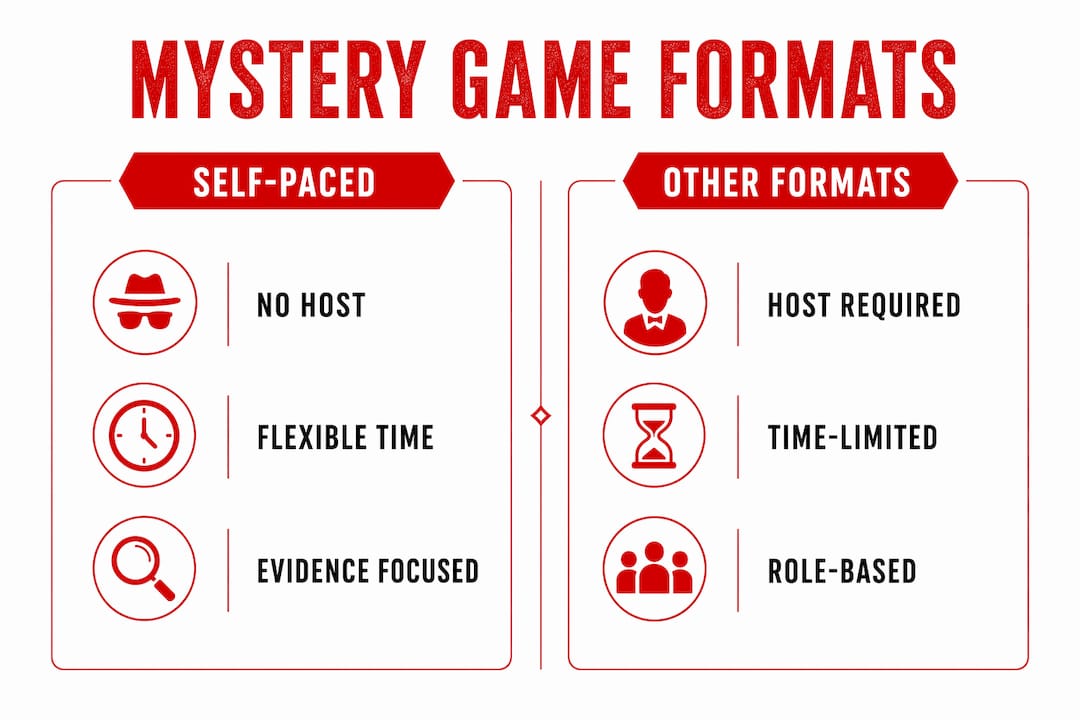
How do self-paced mystery games work for solo players and small groups?
Self-paced mystery games accommodate both solo players and small groups, and each mode has genuine advantages worth understanding before you choose.
Solo play gives you complete control. You set the pace, you decide which lead to follow next, and you can sit with a piece of evidence as long as you need. There are no scheduling negotiations and no waiting for someone else to catch up. For players who enjoy deep focus and uninterrupted analysis, solo mode is often the most satisfying way to experience the format.
Group play works differently but just as well. Asynchronous collaboration lets players share clues and theories on their own time via calls, chat, or screen sharing, while each person maintains their own analysis pace. One player might review the autopsy report on a Tuesday evening while another examines the suspect timeline on Thursday morning. The group reconvenes to compare notes, and the discussion that follows is often the most engaging part of the whole experience.
Here are four practical ways to organize a self-paced group session:
- Assign evidence roles. Give each player a specific category of evidence to analyze first, then share findings before the group discusses the full picture.
- Use a shared document. A live Google Doc or shared notes app lets everyone log observations in real time without needing to be online simultaneously.
- Schedule one sync call. Agree on a single video call at the midpoint to compare theories. This keeps the social element alive without forcing everyone onto the same schedule.
- Set a soft deadline. A loose end date, such as "let's solve it by the weekend," creates light momentum without the pressure of a countdown timer.
Pro Tip: If you are playing with a group remotely, try sharing your screen during the sync call and walking through the evidence together. Seeing the same clue at the same time often sparks connections that individual analysis misses.
What formats and examples of self-paced mystery games can you play at home?
Self-paced mystery games come in several formats, and the right one depends on how you like to engage with a story.
Printable and downloadable case files are the most accessible entry point. These typically include a PDF evidence bundle you print at home, covering photographs, letters, lab reports, and suspect profiles. Printable case files require only a printer, a pen, and a notebook, and most run from 45 to 90 minutes. They suit players who want a low-commitment introduction to the format.
App-based and digital investigations add a cinematic layer. Murder in Prague pairs a physical evidence kit with a digital app, delivering a story set against the real backdrop of Prague. The combination of authentic props and video storytelling creates an atmosphere that printable files rarely match. Players can start on a laptop, switch to a phone, and pick up exactly where they left off.
Multi-session case files are designed for players who want a longer, more complex investigation. Plotted Creatives, for example, offers cases that run from 2 to 5 hours across multiple sessions. These suit players who want to live with a case for a few days and let theories develop between sessions.
- Printable case files: 45–90 minutes, printer required, beginner-friendly
- App-based kits: multi-device access, cinematic presentation, physical props included
- Multi-session cases: 2–5 hours, deeper narrative, best for enthusiasts
- Subscription mystery boxes: monthly physical evidence kits mailed to your door
Quality matters across all formats. The best self-paced games are evidence-complete, meaning all necessary clues and interviews are included upfront so players can pause and resume without losing context. A game that drip-feeds evidence on a schedule defeats the purpose of self-paced play.
What should you look for when choosing a self-paced mystery game?
Choosing the right self-directed investigation game comes down to matching the game's design to your preferences, not just picking the most popular title.
Story complexity and theme are the first filters. Some games focus on cozy, lighthearted mysteries. Others go darker, with forensic detail and morally complex suspects. Read the premise carefully before buying. A game that clashes with your taste will lose you before the first act ends.
Puzzle type and evidence density matter more than most players expect. Case files combine logic puzzles, secret codes, and evidence review over several hours to cater to different engagement levels. If you love cryptography, look for games that feature coded messages. If you prefer narrative deduction, prioritize games with rich character backstories and layered timelines.
Solo versus group support is a practical check. Not every self-paced game scales well to a group. Look for titles that explicitly describe both play modes, or check player reviews for group play feedback.
Duration and pacing flexibility should match your schedule. A 45-minute case works well for a date night. A multi-session investigation suits a week of casual evening play. Some games allow pausing without losing context, which is the feature to prioritize if your schedule is unpredictable.
Pro Tip: Before committing to a full purchase, look for a free sample case or a demo chapter. Many platforms offer a short introductory puzzle that gives you a real feel for the evidence style and difficulty before you invest in the full experience.
Finally, check whether the game is evidence-complete before you buy. A self-paced game that requires external hints or timed releases is not truly self-directed. All the clues you need should be in the box or the download from the start.
Why self-paced mystery games are worth your time
We have played a lot of mystery formats over the years, from elaborate dinner parties to escape rooms with a five-minute warning buzzer. The self-paced format consistently delivers something the others rarely do: the feeling that you actually solved it. When there is no host nudging you toward the answer and no group consensus pulling you along, the moment the pieces click together is entirely yours.
What surprises most first-time players is how much the format rewards patience. You can sit with a suspect's alibi for ten minutes, cross-reference it against a phone record, and feel the satisfaction of catching a contradiction that a faster format would have rushed past. That depth of engagement is what keeps players coming back to self-directed investigation games rather than returning to party formats.
The rise of app-based kits like those from Murder in Prague has also changed what the format can look like. Cinematic video, authentic physical props, and a story set in a real city create an atmosphere that used to require a theater budget. The format has grown up, and the best titles now rival the production quality of premium board games and interactive fiction.
If you have been curious about self-paced detective games but unsure where to start, the honest advice is to just pick one and begin. The learning curve is minimal, the payoff is real, and the format fits almost any schedule or group size.
— Murder in Prague
A cinematic self-paced mystery you can start tonight
Murder in Prague offers a detective investigation kit that puts everything described in this article into a single, ready-to-play experience. The kit pairs physical evidence with a digital app, so you can start on your laptop, pause for dinner, and pick up on your phone later.
