Authentic investigative props turn an at-home murder mystery from passive viewing into an active investigation by adding touchable, research-backed evidence that anchors attention and memory. The verdict is simple: physical clues make the experience investigatory, not just cinematic. If you want that effect without building it yourself, a premium cinematic kit that bundles congruent props with movie-quality video and a companion app is the fastest, highest-impact route. Murder in Prague delivers exactly that combination, and the research behind why it works is worth understanding before your next party night.
Key Takeaways
Physical investigative props increase immersion, memory, and collaborative engagement because the brain integrates haptic and visual inputs into a unified sense of presence that passive viewing cannot replicate.

Why authentic props elevate parties: the cognitive science behind the thrill
The brain does not treat touch as a bonus input. It treats haptic feedback as a reality cue, integrating what your hands feel with what your eyes see and your ears hear into a single, unified "being there" state. several psychological researchers confirm that adding tactile and haptic stimulation to audio-visual narratives measurably increases reported presence and emotional engagement in entertainment contexts. In plain terms: holding a suspect's file while watching them deny everything on screen makes the denial feel personal.
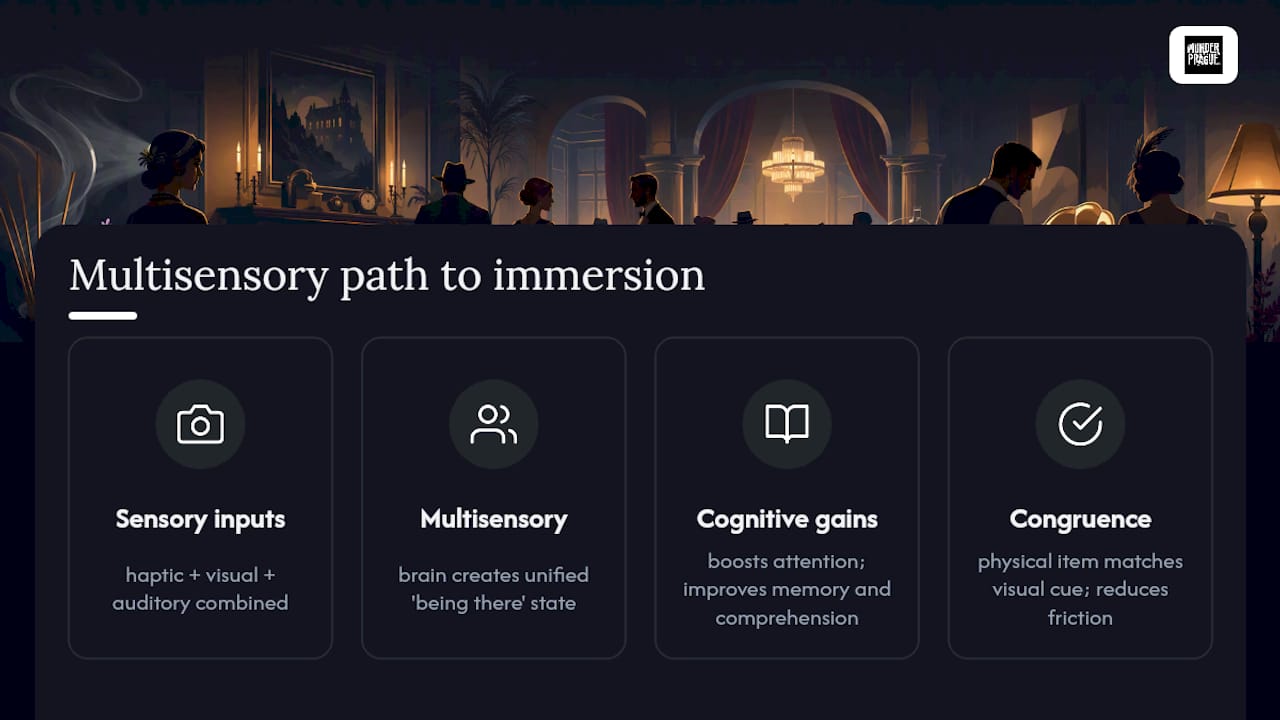
This mechanism has a name in cognitive science: multisensory integration. When haptic and visual inputs are congruent, the brain stops evaluating the experience and starts living it. An Educational Psychology Review paper found that haptic exploration of real objects boosts attention and can improve memory and comprehension for complex materials compared with visual-only presentation. That matters enormously for a murder mystery, where players need to hold multiple threads in mind across a two-hour investigation.
A 2026 scoping review of 72 empirical studies identified sensory congruence and narrative orchestration as the two most repeatable design principles for effective haptic-mediated immersive experiences. Congruence is the key word: the physical item must match what the story shows. When it does, cognitive friction drops and immersion rises. When it does not, participants spend mental energy reconciling the mismatch instead of chasing the killer.
There is one important nuance. A 2026 mixed-reality study found that tactile input yields the strongest benefits when visual cues alone are ambiguous or potentially misleading. For an investigation full of contradictory testimony and forged documents, that is almost every clue.
Pro Tip: When choosing or evaluating a kit, check that every physical item in the evidence box has a direct visual counterpart in the video. That visual-tactile match is what the research calls congruence, and it is the single biggest driver of immersion quality.
What physical evidence actually does during an investigation
Props become active evidence. investigators touch, compare, and test hypotheses rather than only watch. That shift from observer to investigator is the core experiential difference between a cinematic kit with a real evidence box and a streaming-only mystery.
Here is what that looks like in practice, broken down by observable effect:
-
Retrieval cues. A 2004 experimental study showed that context-specific props improve recognition and organization of event details during complex tasks. Picking up a phone record mid-investigation triggers recall of the scene where that number appeared.
-
Clue linking. Physical items can be placed side by side. Players lay a bank statement next to a handwritten note and spot the date discrepancy that the video alone would never make obvious.
-
Emotional stakes. Holding something that "belongs" to a victim or suspect creates a visceral connection. The story stops being abstract.
-
Social role catalysis. One person reads the case file aloud while another cross-references the app. Roles emerge naturally from the props themselves.
-
Pacing anchors. The evidence box sequences the investigation. When the group finishes examining one item, the next video beat feels earned rather than arbitrary.
-
Tangible verification. Players can physically confirm or rule out a theory by returning to an item, which reduces argument friction and keeps the group moving forward.
Imagine this: a handwritten note surfaces in the evidence box, apparently from the victim, dated the night of the murder. Half the group is certain the suspect on screen wrote it. The other half points to the signature. The argument lasts ten minutes, everyone is leaning in, and the video has not even resumed yet. That is what a well-designed physical clue does to pacing and group energy.
How authentic props make your party night genuinely better
Authentic props convert curiosity into collaborative action and emotional investment. That is the social payoff, and it plays out differently depending on who is in the room.
-
Couples work through the evidence together, building a shared narrative and a private shorthand for the suspects. The interactive icebreaker dynamic is real: cooperative problem-solving under mild pressure creates closeness.
-
Families benefit from inclusive task distribution. Younger players handle and describe physical items while older players cross-reference the app. The props give everyone a role without anyone needing to assign one.
-
Friend groups get competition, bragging rights, and the satisfaction of a shared reveal. Physical evidence creates moments of genuine surprise that screenshots cannot replicate.
Across all three groups, props solve the pacing problem that kills most at-home party nights: dead air between video beats. When players have something to hold and examine, downtime disappears. The character-driven narrative structure of a well-designed investigation keeps that energy directed rather than scattered.
Pro Tip: Before the investigation starts, place the evidence box in the center of the table and tell everyone not to open it yet. That single staging choice builds anticipation and signals that the items inside are meaningful, not decorative.
How to set up and present authentic evidence without spoiling the investigation
Deliberate staging and clear handing rules preserve immersion and investigative flow. Here is a practical checklist for hosts:
-
Stage the evidence box before guests arrive. Arrange items in the order the video will reference them. Do not let players free-browse the box at the start.
-
Sync the companion app before the first scene plays. Test the in-app phone calls and text interactions on the device you will use. A technical hiccup mid-investigation breaks atmosphere fast.
-
Introduce items at the right video beat. Pass a physical clue to the group only when the corresponding scene has played. This preserves the reveal and keeps the narrative coherent.
-
Set a "no peeking" rule for sealed envelopes. If the kit includes sealed documents, treat them as locked until the story unlocks them. The anticipation is part of the experience.
-
Manage the reveal pacing. After a major clue, pause the video for two to three minutes of group discussion before advancing. Props need time to do their cognitive work.
-
Accessibility swaps. For players with sensory sensitivities, describe items aloud before passing them. For families with young children, designate one adult as the "evidence keeper" who controls what gets handled and when.
A full guide to structuring a mystery party night covers timing in more detail, but the core principle is simple: the video drives the story, and the props drive the investigation. Keep those two tracks synchronized.
Pro Tip: Use labeled envelopes marked "Open only after Scene 3" to create a lockbox moment. The physical act of opening a sealed envelope at the right moment is one of the highest-tension beats in any investigation night.
What to expect from a premium cinematic investigation kit
A premium kit bundles cinematic runtime, curated physical evidence, and app interactions sized for social groups. Here is what that looks like in practice:

The cost difference matters. A physical escape room for two to four people in most U.S. cities runs $25–$40 per person. A cinematic kit at home delivers comparable investigative depth at a movie-ticket price point per person, with the added advantage of your own couch, your own snacks, and no time pressure from a booking slot.
Authentic materials justify the premium over generic or DIY alternatives. Research on augmented virtuality shows that physical replicas paired with high-quality visuals increase perceived realism and enjoyment, but fidelity matters: a poorly finished prop creates the same cognitive friction as a mismatched one.
How Murder in Prague is built around the research
Murder in Prague combines movie-quality narrative with tactile evidence and timed app interactions to maximize multisensory congruence and investigative agency. Every design choice maps directly to the mechanisms the research describes.
-
Cinematic video shot on location in Prague with an award-winning cast gives the visual channel the production quality that makes haptic congruence possible. The actors are believable; the locations are real.
-
Physical evidence box containing case files, phone records, and physical clues gives players something to hold while the story unfolds on screen. The brain integrates those streams, into a heightened sense of presence.
-
Companion app delivers in-game phone calls and texts at scripted moments, adding a third sensory channel that reinforces the narrative without breaking the physical investigation.
-
Narrative orchestration sequences evidence to match video beats, implementing the congruence principle from the 72-study scoping review.
Picture this: a suspect is speaking on screen, denying any knowledge of the victim's finances. You are holding the bank record that proves otherwise. The Educational Psychology Review research on haptic encoding explains exactly why that moment hits harder than any streaming mystery: your hands are telling your brain this is real. The result is cooperative deduction that feels genuinely high-stakes, not performed.
The reason we built it this way
The intent behind Murder in Prague was always to create a Netflix-level investigation you can hold in your hands. Not a board experience, not a printable puzzle pack. A cinematic story where the physical evidence and the on-screen narrative are so tightly interwoven that the line between watching and investigating disappears.

There is a specific moment that captures why this matters. A group is gathered on a couch. The suspect on screen is mid-confession. One player is holding a handwritten note from the evidence box, cross-referencing it against what the actor is saying, and the room goes completely quiet. That silence is not passive. It is the sound of everyone thinking at the same time, pulled into the same story, chasing the same answer together. That shared intensity is what "excited togetherness" actually means in practice, and it only happens when the physical evidence and the cinematic narrative are working in concert.
Ready to run your own cinematic investigation?
Murder in Prague delivers escape-room-level immersion at a movie-ticket price, without venue booking, travel, or a ticking clock on the wall. The Detective Investigation Kit ships the complete physical evidence box to your door and activates the companion app the moment you are ready to investigate.
Here is what you get when you order:
- Cinematic video access featuring an award-winning cast shot on location in Prague
- Physical evidence box with case files, phone records, and tactile clues
- Companion app with in-game calls, texts, and digital evidence
- Original noir soundtrack woven through the investigation
- Designed for 2–6 players across a 2–3 hour investigation night
Shipping is straightforward, app activation takes minutes, and the investigation is ready to run the same evening the box arrives. Order the Murder in Prague kit and give your next party night a story worth remembering.