The benefits of prop-based plays come down to five measurable payoffs: stronger social bonding, eudaimonic enjoyment, sensory immersion, real agency, and documented mental-health gains like lower anxiety and higher empathy. Murder in Prague is the clearest example of the format done at a premium level, pairing a physical evidence box with cinematic video so a living room becomes an interrogation room.
What you actually feel during a night like this:
- A shared "wait, WHAT?" moment when the group connects a phone record to a suspect's on-screen lie
- The strange thrill of holding a case file while the person it belongs to talks to you from the screen
- Pacing that builds like a film, not a board game, so tension escalates instead of stalling
Key Takeaways
Premium prop-based investigations work because realistic physical evidence synced to cinematic video restores agency, empathy, and shared focus more reliably than passive entertainment.

The Psychology Behind Why Immersive Investigations Feel So Satisfying
Interactive, story-driven experiences hit three psychological needs that passive entertainment mostly skips: agency, autonomy, and relatedness. You are not watching a detective solve a case. You are the one deciding which lead to chase, and that shift changes how the brain processes the story.
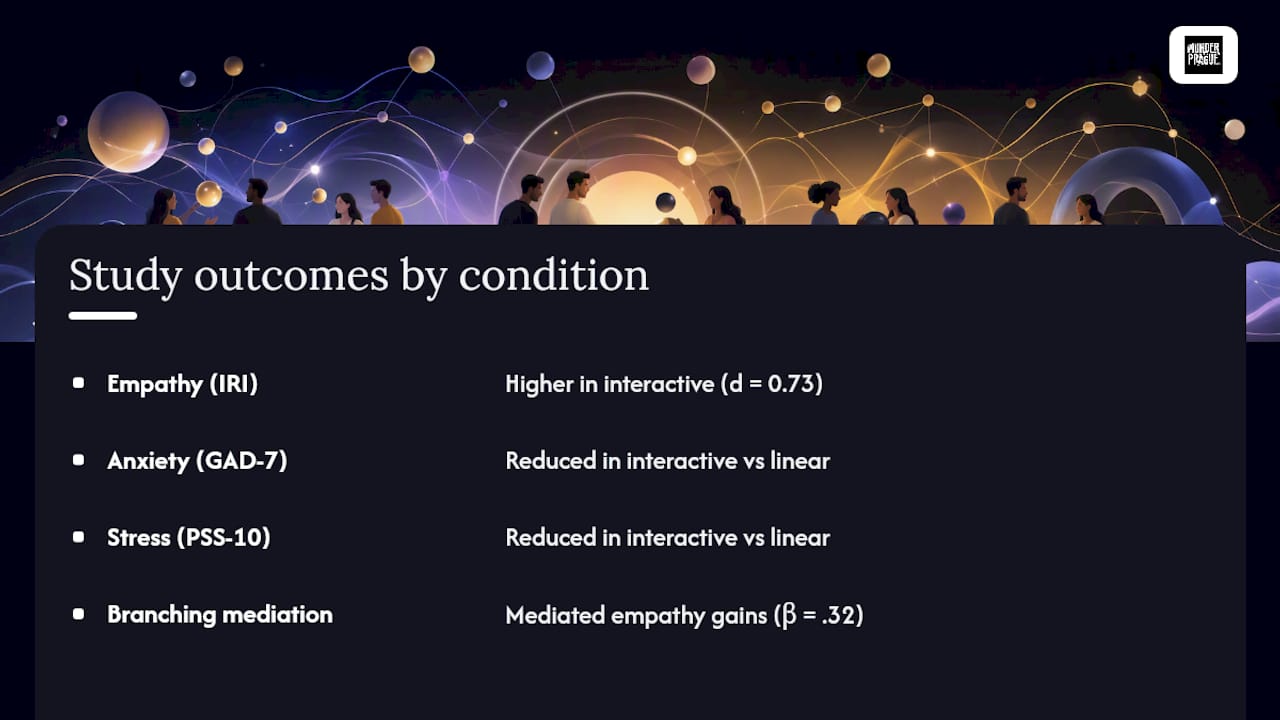
A randomized mixed-methods study on interactive narratives found participants in the interactive condition scored higher on empathy measures, alongside reductions in anxiety and stress compared to a linear control group. Notably, the branching structure of investigation itself mediated the empathy gains, together with option of choice, not just story quality, appears to drive the effect.
This connects to what media psychologists call eudaimonic enjoyment: a deeper, meaning-driven satisfaction distinct from the quick hit of hedonic pleasure you get from a sitcom. Untangling a lie under pressure produces a different kind of buzz than laughing at a punchline, and it tends to stick with you longer.
Pro Tip: Let branching moments breathe. When the group hits a decision point, pause and let people argue their theory out loud before revealing the next scene. That friction is where the empathy gains actually happen.
How Realistic Props and Cinematic Video Create Deep Immersion
Sensory congruence plus real agency equals immersion. When what you touch matches what you see and hear on screen, your brain stops treating the experience as "a game" and starts treating it as real. Break that match, and the illusion collapses instantly.
Two mechanisms do the heavy lifting:
-
Multisensory congruence: tactile, visual, and audio cues that align with the story reduce cognitive friction and increase the feeling of presence, a pattern confirmed in Oxford's review of touch in home entertainment
-
Tactile agency: physically sorting paper evidence and cross-referencing case files builds a stronger sense of "I am the investigator" than tapping a screen ever does, according to research on touch in immersive entertainment
The inputs that matter most: physical case files, believable phone or bank records, props that map directly to specific video cues, tightly cut cinematic pacing, and in-world calls or texts that arrive at the right dramatic beat. The flow runs sensory input to cognitive processing to immersion outcome, and each stage depends on the one before it.
Picture this: a suspect's face fills the screen mid-interrogation, and you are holding the bank statement that proves he's lying. You are not watching the scene. You are inside it.
Pro Tip: If a prop doesn't map to a specific on-screen moment, cut it. Decoration without a payoff dilutes immersion instead of building it.

Participants come away with something a passive movie night rarely produces: a shared emotional peak they keep talking about days later. That's not incidental. Research on emotionally intense shared experiences links joint attention during high-arousal moments to measurable increases in mutual connectedness.
Where this plays out:
-
Date night: solving a case together creates a different kind of intimacy than watching a movie side by side
-
Family evening: kids and adults handling the same physical clues levels the playing field in a way board games rarely manage
-
Friend groups and true-crime fans: the double-date icebreaker effect scales naturally to a full table
Passive movie nights give you a shared room. This gives you a shared focus, active roles, and a discovery moment nobody saw coming.
Pro Tip: Orchestrate the big reveal as a group moment. Pause the video right before a twist and let everyone commit to a guess out loud. Being wrong together bonds a group faster than being right alone.
What to Look for in a Premium Prop-Based Investigation Kit
Prioritize production quality, prop authenticity, and how tightly the physical evidence maps to the video before anything else. A kit that nails story but ships flimsy paper props, or one with gorgeous props and a thin plot, both fall short of the immersion the format promises.
Run any option against this checklist:
-
Cinematic production: on-location shooting, a genuinely trained cast, film-grade sound design rather than a webcam skit
-
Prop authenticity: paper evidence that feels sealed and official, phone records and bank statements that look real under a lamp
-
Multisensory features: timed calls, texts, or audio cues that land at the right dramatic beat
-
App integration: does the companion app sync cleanly with each scene, or does it lag behind the story
-
Group support: clear pacing guidance for two people versus eight, since a couple's date night and a twelve-person party need different rhythms
For couples, weight cinematic intimacy and pacing higher. For larger groups, weight app clarity and role division higher, since confusion multiplies fast past six people. Formats built around investigative puzzle experiences vary widely on exactly these axes.
Pro Tip: Before buying, check whether the props are described as "semantically congruent" with the video, meaning each physical item corresponds to a specific on-screen moment rather than sitting there as set dressing.
How to Host a Prop-Based Investigation Night Without a Hitch
Your job as host is atmosphere, pacing, and protecting the illusion, not running a quiz show. Get the room right and the story does most of the work for you.
Setup checklist:
- Dim the lighting and kill background noise before the first scene starts
- Lay out evidence within reach of everyone, not stacked in front of one person
- Charge every device the companion app needs and test the connection beforehand
- Pre-sort envelopes or role materials if the format calls for individual assignments
Pace the evening the way a film editor would: let tension build uninterrupted through a chapter, then pause fully between chapters for theories and side arguments. Bigger groups benefit from letting pairs run their own mini-investigation on a side clue before reconvening. This tactic is covered in more depth in guidance on managing a large group mystery night.
If something breaks: missing prop, improvise a verbal description and move on. App sync issue, pause the video rather than plow through confused. Someone can't handle a physical clue for accessibility reasons, assign a partner to narrate it aloud.
Pro Tip: Close with a two-minute debrief where everyone says what clue surprised them most. It turns the ending credits into a shared emotional landing instead of an abrupt stop.
The Research and Production Credentials Behind These Claims
These benefits rest on two separate foundations: peer-reviewed behavioral research and verifiable production quality, not marketing language.
On the research side: interactive narratives measurably increase empathy and reduce anxiety, narrative transportation theory explains why absorbing stories concentrate attention and emotion, and haptic feedback research shows synchronized tactile cues more than double willingness to pay for an enhanced cinematic experience.
On the production side, Murder in Prague brings:
- An award-winning cast shot on location in Prague, not a studio green screen
- Hight resolution video production instead of amateur skits
- Physical evidence, including realistic phone and bank records, built to match specific scenes
Each of these maps directly onto the buying checklist above. Production credentials answer the "is this cinematic enough" question. The evidence design answers the "does it actually feel real in my hands" question.
Designing an Investigation That Earns Its Reveal
We build every case around one rule: the prop in your hands has to matter to the exact scene playing on screen. Suspense collapses the moment a piece of evidence feels decorative instead of load-bearing, so every phone record and case file is written to sync with a specific line of dialogue.
That discipline is what produces the payoff covered throughout this piece. Agency only feels real when the physical object you're holding actually changes what you understand about the story unfolding in front of you.
Bring This Experience Into Your Own Living Room
Murder in Prague is built to deliver every benefit covered above in one box: studio-grade cinematic video, an evidence set with real weight in your hands, and an app that times phone calls and texts to land exactly when the story needs them. You are not reading rules off a card. You are opening a suspect's phone records while his face is still on your screen.
What you get is closer to an escape room's intensity than a board game's routine, delivered at a fraction of the cost and without leaving the couch. It works as a date night that turns into real conversation, a family evening where a shared case levels the room, or a friend group's true-crime obsession finally given something to actually investigate together.
Pick your evening, then check availability on the Detective Investigation Kit and get your copy of the full cinematic experience shipped and ready before your next gathering.