

Most murder mystery parties fail before the first clue drops. The common murder mystery hosting mistakes that derail an otherwise great night are almost always avoidable, and each one has a fast fix. Here is the quick triage list every host needs before planning begins.
The most damaging hosting mistakes and their one-line fixes:
- Sending character packets too late — Mail or email roles well in advance so guests can prepare costumes and backstory.
- Assigning roles at the door — Pre-assign every character based on personality before the night, never on arrival.
- Skipping the rules read — Open with a mandatory 5-minute silent read so every guest absorbs their role before the first scene.
- Dumping all clues at once — Drip clues every 15–20 minutes or tie releases to meal courses to maintain tension.
- Wrong format for the group — Match your format (dinner, cocktail, self-paced) to your guest mix, not your décor vision.
- Flat lighting and no music — Swap overhead fluorescents for warm lamps or candles; queue a thematic soundtrack before guests arrive.
- Food that interrupts scenes — Use buffet or potluck service so you can facilitate without running to the kitchen.
-
No contingency for no-shows — Prepare a merged or standby role so one cancellation does not collapse the plot.
- Rushing the reveal — Build a dramatized accusation round; never just read the answer aloud.
-
Ignoring quiet guests — Assign lighter, reactive roles to introverts and check in with scripted nudges during play.
TL;DR: Pre-send character packets, open with a 5-minute silent read, drip clues at timed intervals, and keep your guest count manageable. Do those four things and the night almost runs itself.
How do you assign roles without wrecking the group dynamic?
Assign roles to fit personalities. Forcing an introvert into a lead monologue role is one of the fastest ways to kill the energy in the room, and it is entirely preventable with a short personality check before you finalize the cast list.
Role assignment rules:
- Give extroverts the characters with the most secrets to reveal and the most scenes to drive.
- Reserve lighter, reactive roles (witnesses, minor suspects) for quieter guests who prefer responding over initiating.
- Include at least one "optional spotlight" role that a shy guest can lean into if they warm up, without being required to perform.
- Never assign the murderer role to someone who will feel genuinely uncomfortable carrying a secret all night.
Guest fit checklist:
- Does this guest enjoy improv or theatrical play?
- Will they read their character packet before arriving?
- Do they know at least two other guests well enough to banter with?
- Are they comfortable with a little misdirection and bluffing?
For last-minute substitutions, the cleanest fix is a pre-written "neutral observer" role you can hand to an unexpected plus-one. This character knows one minor clue and can interact freely without disrupting the plot. If a key character cancels entirely, merge their most critical clue into another character's packet the morning of the event. Mysteries work well as social icebreakers for mixed groups, but only when every guest has a role they can actually inhabit.
When should you send invitations and character packets?
Send character packets at least 3–6 weeks before the event, with the longer lead time for busy holiday seasons or complex roles. Expertsb especially recommend giving guests enough advance time to prepare costumes and absorb their backstory, and that preparation gap is what separates a confident, in-character guest from someone reading their bio at the table.
Every character packet should include:
- Character name, occupation, and relationship to the victim
- Key facts the character knows (and what they are hiding)
- Costume suggestions with two or three specific options
- A brief summary of the Investigation's tone and style so guests set the right expectations
- Logistics: date, time, address, parking, dress code, and RSVP deadline
Pro Tip: For sensitive plot details, use sealed envelopes labeled "Open on arrival" or password-protected PDFs. Keeping the murderer's full instructions private until the night preserves the surprise for everyone, including the murderer themselves.
material packets feel more immersive than a plain email, but a well-formatted PDF works perfectly for guests who live far away or are prone to losing paper. Rookie mistakes like skipping host materials or only one copy of the host guide are exactly the kind of prep failures that compound on the night itself.
How do you pace the evening without dominating it?
Poor facilitation is the mistake hosts underestimate most. Talking too much, holding clues back too long, or rushing the final reveal all flatten the experience in different ways. The host's job is to guide the story, not perform it.
Facilitation checklist:
- Open with a 5-minute silent read. Enforcing this quiet phase is one of the most effective things a host can do to prevent confusion in the first 20 minutes.
- Set a timer for your first clue drop (15–20 minutes after the silent read ends).
- Monitor the room. If two guests are dominating and three are silent, use a scripted nudge.
- Release the next clue on schedule, regardless of whether the group has "solved" the previous one.
- If conversation stalls, introduce a surprise element: a phone call from a suspect, a new piece of evidence, or a character revelation.
- Never answer direct "who did it?" questions. Redirect with: "That's a great theory. What evidence supports it?"
- Signal the accusation round clearly: "You have 10 minutes to make your final accusation. Choose carefully."
Sample facilitator nudges:
- To a quiet guest: "[Character name], I heard you were the last person to see the victim. What exactly did you see?"
- To a runaway theorist: "Hold that thought — let's hear from someone who hasn't weighed in yet."
- To a stalled group: "A new piece of evidence just arrived. Let me read it to everyone."
What atmosphere details actually move the needle?
Atmosphere makes or breaks immersion, and the gap between a flat party and a cinematic one often costs nothing. Event pros consistently point to lighting as the highest-impact, lowest-cost change a host can make. Overhead fluorescents kill mood instantly. Warm candle-warmer lamps or string lights transform the same room into a period noir setting. For a modern thriller, cooler, harsher directional light creates unease without a single prop.
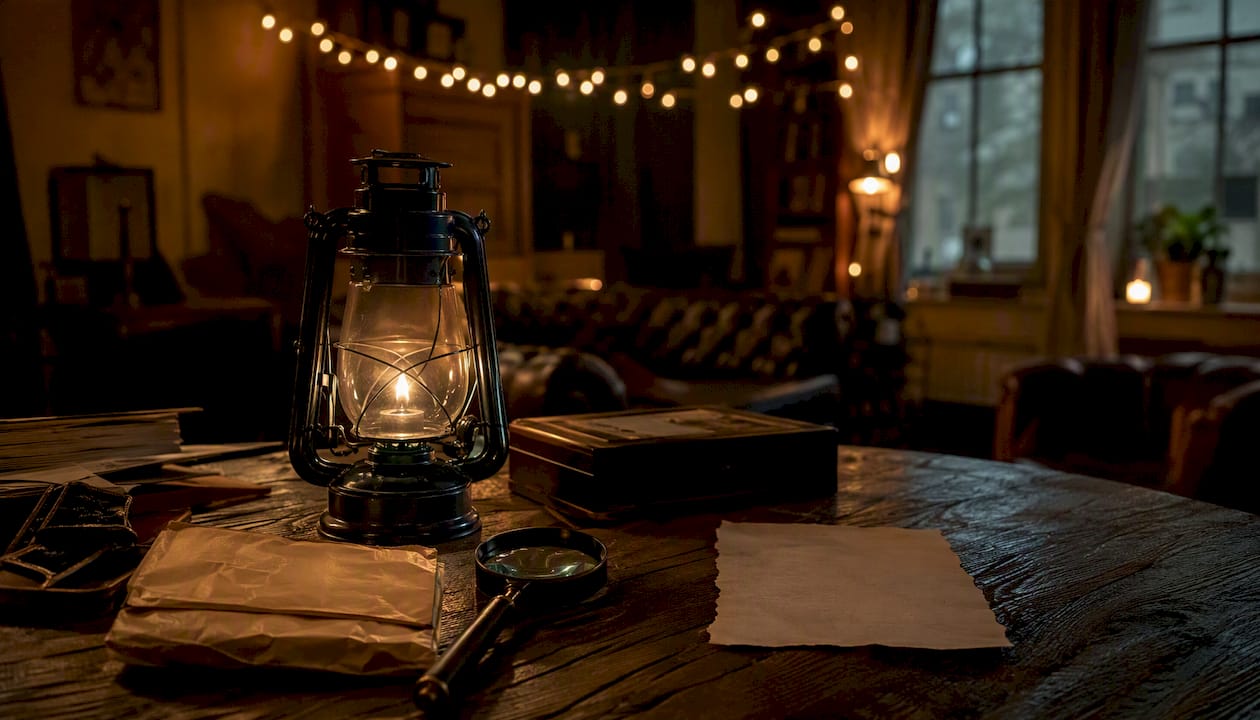
Music fills the silence that kills tension. Queue a thematic playlist before guests arrive and let it run at low volume throughout the investigation. Silence between scenes reads as awkward; the right soundtrack reads as suspense.
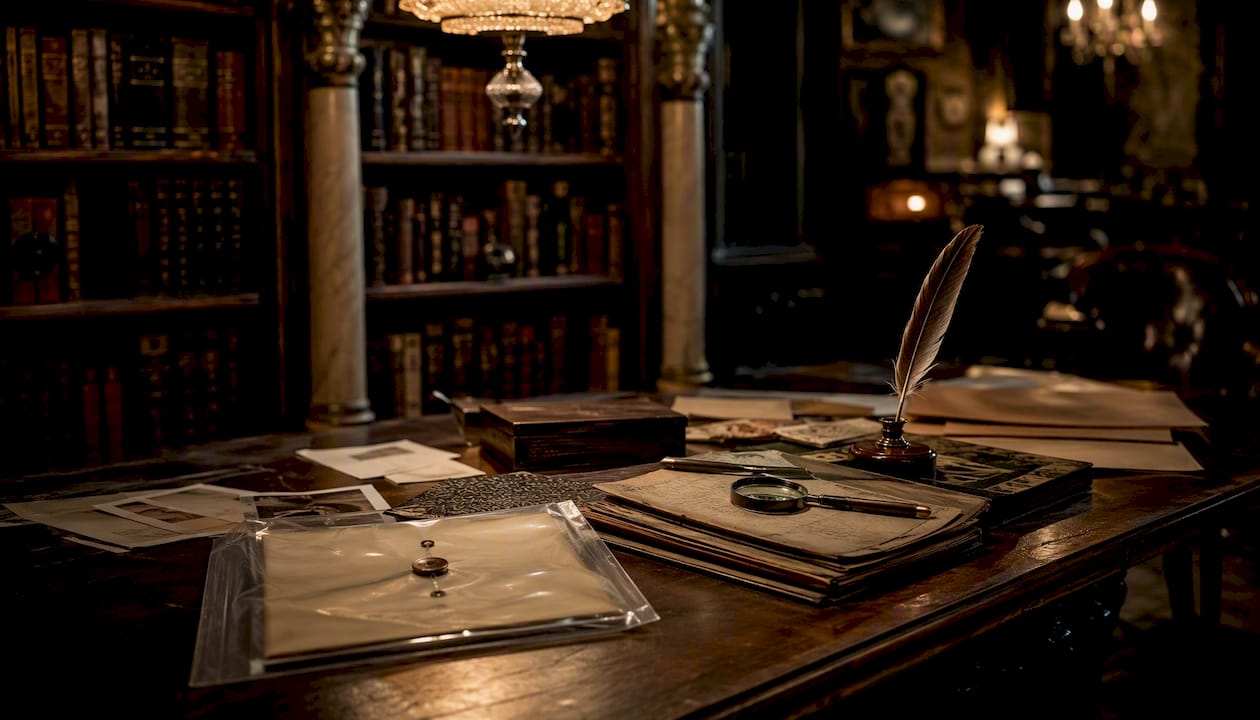
For props, believability beats quantity. A single realistic-looking case file, a handwritten note, or a sealed evidence bag does more for immersion than a table covered in plastic skulls. Source period-appropriate props from thrift stores, realistic documents on aged paper, and avoid anything that looks obviously purchased from a party supply store.
Pro Tip: Convert one corner of your space into a dedicated "evidence table" with a single lamp, a magnifying glass, and all physical clues arranged as if a detective just left the room. Guests gravitate toward it naturally, and it creates a visual anchor for the investigation.
How do you handle spoilers, no-shows, and quiet players?
Have three quick plans ready before the night starts. Troubleshooting guides consistently flag no-shows, spoilers, and disengaged guests as the most frequent operational problems, and each one has a fast fix if you have thought it through in advance.
Fast decision flows:
-
Spoiler situation — A guest accidentally reveals the murderer's identity early.
- Immediate fix: Introduce a "plot twist" card that reframes the reveal as misdirection. Say: "Interesting theory. But we just received new evidence that complicates that." Then drop a red herring clue.
- Fallback: Acknowledge it lightly and shift focus to the how and why rather than the who.
-
No-show situation — A key character does not arrive.
- Immediate fix: Merge their one critical clue into another character's packet before guests sit down.
- Fallback: Announce that the character "sent a message" and read their key information as a scripted note.
-
Quiet player situation — A guest is not engaging and the group is losing energy.
- Immediate fix: Direct a scripted question to their character by name (see facilitation nudges above).
- Fallback: Assign them a physical task, such as organizing the evidence table or reading a clue aloud, to give them a low-pressure entry point.
Quick decision checklist for time-pressed moments:
- Is the plot still solvable without the missing information? If not, merge the clue immediately.
- Has the quiet guest been directly addressed at least once? If not, use a scripted nudge now.
- Is the spoiler genuinely damaging or just a theory? If it is a theory, redirect; if it is a confirmed spoiler, use the plot twist card.
How many guests and how long should the evening run?
Too many players and the investigation fragments into side conversations that never reconnect. Too few and there is not enough suspicion to spread around. Most guides recommend 6–12 players for a dinner-style mystery, with a runtime of roughly 2–3 hours. The sweet spots by format:

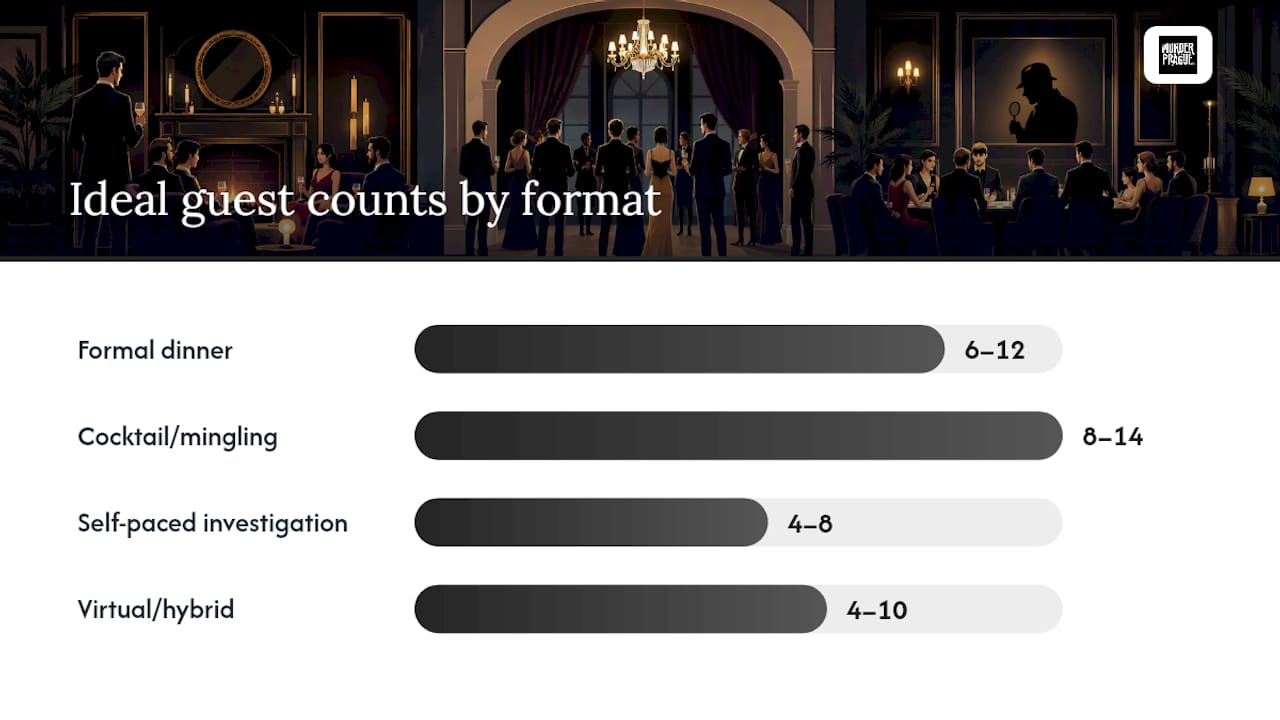
For larger groups, split players into investigation teams of 4–5 and have each team work the same clues independently before reconvening for a group accusation. This keeps everyone active without the chaos of 14 people talking over each other. For managing large-group mystery experiences, structured team play is the most reliable format.
For virtual adaptations, cut the runtime by 30 minutes, use a shared screen for video clues, and assign a digital "evidence folder" each guest can access. Breakout rooms work well for private character conversations. Keep the guest count under 10 for virtual formats; larger groups on video calls lose the intimacy that makes the investigation feel real.
How do you close the night without killing the mood?
A poor reveal is the most common ending mistake in themed party planning, and it is the one guests remember longest. Reading the answer from a card without ceremony deflates everything that came before it. Close with drama.
Reveal structure:
- Collect written accusations from every guest simultaneously (prevents one person from influencing others).
- Read accusations aloud, building suspense by saving the most confident accusation for last.
- Perform the murderer's confession, either as a scripted monologue the murderer reads aloud or as a host-narrated reveal with the murderer reacting in character.
- Follow with a 10-minute debrief: "What was your first suspect? When did you know? What clue threw you off?"
Small prizes reinforce the experience without distracting from earlier scenes. A "Best Detective" award for the guest who solved it, a "Best Performance" for the most committed character, and a "Most Suspicious" for the guest who fooled everyone the longest. Keep prizes small and thematic: a magnifying glass keychain, a mini flask "detective's certificate." The recognition matters more than the prize itself.


