


The best approach for families is a cooperative, scaffolded mystery experience with adjustable hints and readable clues, so every age group stays challenged without anyone hitting a wall of frustration.
Here is a fast format-to-age-range guide to get you started:
- Under 8: Short cooperative board-style experiences with tactile mechanics, a typical session lasting a brief time suitable for young attention spans, minimal reading required. Outfoxed! is a strong example, targeting ages 4+ with an evidence-scanner that makes deduction physical and fun.
- 8–12: Boxed party kits or narrative-driven graphic novel mysteries.
- 13+: Cinematic interactive investigations with physical evidence and companion apps, where complexity can scale up as players grow more confident.
- Mixed-age families: App-supported investigations with built-in hint systems and role assignment, so adults handle complex inference while younger kids contribute meaningfully.
Quick next step: Pick a self-paced mystery experience with a built-in hint system. It gives you the most control over difficulty without stopping the fun.
How do you choose a mystery experience that fits your family's ages?
The fastest way to avoid a frustrating evening is to run through a short checklist before you buy or book anything. Not every experience that says "family-friendly" actually delivers balanced difficulty for a mixed-age group.
Six criteria to evaluate quickly:
- Adjustable difficulty or hint system — Does the experience include a built-in hint mechanism, or will you be improvising? A formal hint system is non-negotiable for mixed-age groups.
- Cooperative vs. competitive structure — Cooperative formats remove head-to-head pressure and let adults scaffold younger participants naturally. Competitive formats can work for older kids but often leave younger ones behind.
- Recommended age range — Check the stated minimum age and take it seriously. An experience designed for adults will have clue density and thematic content that frustrates a nine-year-old.
- Session length — Attention spans vary wildly. A 90-minute investigation is ambitious for a group with kids under ten. Look for experiences that can be paused or broken into chapters.
- Thematic content screening — Scan product descriptions for mentions of graphic violence, mature themes, or frightening imagery. More on this in the age-group section below.
- Physical vs. digital components — Physical evidence (printed files, prop items) tends to engage younger children more than screen-only experiences. A hybrid approach, physical plus app, usually works best across ages.
Three questions worth asking before you buy:
- Can we pause and resume without losing progress?
- Are the clues readable, meaning can a child understand what they are looking at, or are they deliberately obscured?
- What is the content rating or parental guidance note?
Pro Tip: When reading a product page, look for phrases like "adjustable hints," "host controls," or "self-paced." If the description only mentions difficulty without explaining how it is managed, the experience likely has no scaffolding built in, and you will be on your own when someone gets stuck.

Which mystery formats work best for families, and when should you pick each?
Five main formats exist, and each has a different sweet spot for age range, group size, and how much control you have over difficulty during play.
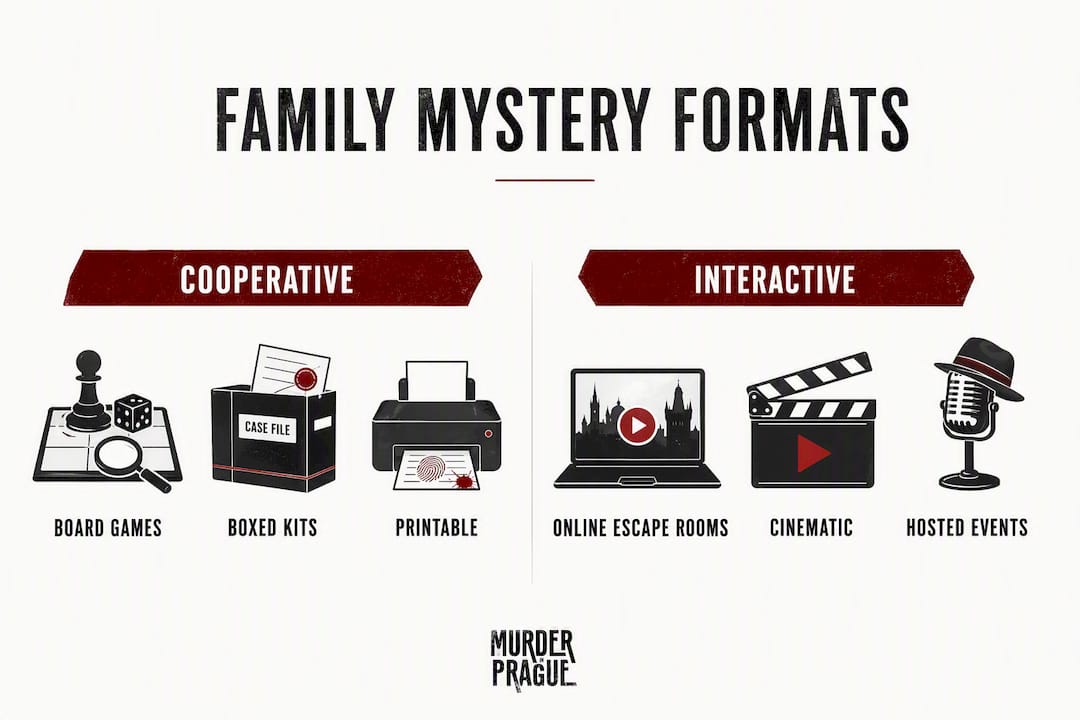
Cooperative board-style experiences
These are physical tabletop experiences where the whole group works together toward one shared goal. Setup is usually quick, rules are learnable in minutes, and the cooperative structure means no one is eliminated or left out.
Boxed party kits
Pre-packaged mystery kits typically include printed clue cards, character dossiers, and a scenario booklet. They suit groups of 4–8 and work well for ages 10 and up. Setup takes 15–30 minutes, and difficulty is largely fixed, so you will need to improvise scaffolding for younger players. The upside is flexibility: you can spread them across an evening or a weekend.
Hosted online escape rooms
A live facilitator guides your group through a virtual escape room via video call. Difficulty is often adjustable in real time because the host can drop hints or redirect attention. These work well for tech-comfortable families with older children (12+), though the screen-only format can disengage younger kids quickly.
Cinematic interactive investigations
This format combines movie-quality video with physical evidence and a companion app. Families watch scenes, receive in-app calls from suspects, and examine real-feeling case files. The Murder in Prague Detective Investigation Kit is the standout example: physical evidence, app-delivered hints, and cinematic video work together so the host can pace discoveries and dial difficulty up or down. Best for ages 13+ or mixed-age families where teens and parents are the primary investigators.
DIY printable options
Free or low-cost printable mystery scenarios downloaded online. Maximum flexibility, zero cost, but zero scaffolding. You build the hint system yourself, which takes preparation time. Good for creative parents who want full control; not ideal when you want a polished, immersive experience.
Pro Tip: For a mixed-age family night with teens and younger siblings, the cinematic investigation format gives you the most levers to pull. The app handles hint delivery, the physical evidence keeps younger kids tactilely engaged, and the video content holds everyone's attention between clue-solving stretches.
What should you pick for each age group, and how do you adapt difficulty?
Age-appropriate guidance matters more here than in almost any other entertainment category, because a mystery that is too obscure for a child does not just bore them. It shuts them out of the shared experience entirely.
Under 8
Choose: Short cooperative board-style experiences with tactile components and minimal reading. Outfoxed! (ages 4+, 15–30 minutes) is purpose-built for this group.
Avoid: Any experience requiring sustained reading, abstract deduction, or competitive elimination. Frightening imagery, even cartoonish, can derail the evening for sensitive children.
Adaptations:
- Assign younger children a specific physical role: "You hold the evidence cards and hand them to us when we ask."
- Use only two or three clues at a time rather than presenting the full evidence set.
- Celebrate every small discovery loudly. The emotional reward keeps them invested.
Ages 8–12
Choose: Narrative-driven mystery experiences with moderate clue density.
Adaptations:
- Let kids in this group lead one chapter or scene independently before adults step in.
- Use a "three hints before we look it up" rule to preserve challenge while preventing frustration.
- Assign roles by strength: a child who loves reading handles documents; a child who loves patterns handles visual clues.
Ages 13+
Teens can handle complex inference, multi-step deduction, and narrative ambiguity. This is the group where a cinematic interactive investigation with layered evidence and app-based interactions genuinely shines. Scale up complexity by limiting hint use, adding a time constraint, or asking players to build a written case theory before revealing the solution.

Content note: Teens can engage with mild crime themes and morally complex characters, but check for graphic violence or adult content before purchasing. Most cinematic investigation kits aimed at this group are designed with mature-but-not-explicit content.
Mixed-age families
Cooperative mystery formats reduce frustration by removing head-to-head pressure and letting adults scaffold younger participants while older players handle complex inference. The key is role assignment: give every person a defined job so no one is passive.
Pro Tip: Before the investigation starts, spend two minutes assigning roles out loud: "You are our evidence keeper. You are our note-taker. You are our suspect tracker." Children who have a named role stay engaged far longer than children who are just watching.
Content red flags to screen for: graphic crime-scene imagery, adult romantic content, jump-scare audio, and references to substance abuse. Most family-oriented mystery apps, list parental guidance notes directly in their descriptions. Always read those before handing a device to a child.
How do you keep the investigation fun when it starts to stall?
Even a well-chosen experience can hit a wall. Someone gets stuck, the energy drops, and suddenly the mystery feels like homework. These in-play adjustments fix that without breaking immersion.
- Deliver a controlled hint. State one piece of information the group already has but has not connected yet. "You know the victim's phone was last used at 11 PM. You also know the suspect claims to have been at dinner until midnight." You are not giving the answer; you are pointing at the gap.
- Split the work. If the group is staring at the same clue together, divide the evidence set. Give each person or pair a different document and ask them to report back in five minutes. Parallel investigation restores momentum fast.
- Call a pause-and-debrief checkpoint. Stop the clock, summarize what the group knows, and ask one open question: "What do we still not know?" This resets focus and often surfaces a connection someone had mentally filed away.
- Simplify the active clue set. Remove two or three pieces of evidence from the table temporarily. Clue overload is a real phenomenon; narrowing the field often produces a breakthrough within minutes.
- Use a character-led prompt. In cinematic investigations, replay a short scene and ask: "What is this character trying to hide?" Reframing the question from "what does this clue mean" to "what does this person want" often unlocks lateral thinking in younger players.
For note-taking during complex investigations, structured evidence tracking makes a measurable difference in how quickly groups move through stalled moments. A simple note-taking approach keeps the evidence organized and visible to the whole group.
Pro Tip: The single most underused adjustment is the "evidence reframe." Instead of adding a new hint, pick up a clue the group has already dismissed and say: "We haven't really looked at this one yet." Returning to existing evidence feels like discovery, not rescue, and preserves the tension of the investigation.
Why do some mystery experiences feel solvable while others feel impossible?
The answer almost always comes down to clue design, not clue quantity. Good difficulty is readable: players should be able to learn from failure because the rules and telegraphs are obvious, not punish them with hidden requirements they had no way to anticipate. When a child fails to solve a clue because the answer was buried in fine print or required knowledge they were never given, that is obscurity, not difficulty. Those are completely different experiences.
Game-balance design shapes difficulty independently from the learning curve. A well-calibrated investigation trusts participants and provides information that lets them master the case by evaluating evidence, not by memorizing irrelevant details. For families, this means the best experiences front-load the rules clearly, make clues visually distinct, and build in informative failure: when you get something wrong, the experience tells you why in a way that points you back toward the right path.
"Effective difficulty is 'readable' rather than obscure: players should be able to learn from failure because the rules and telegraphs are obvious, not punish them with hidden requirements." — Game design research on informative failure
Murder in Prague illustrates this calibration in practice. The investigation pairs cinematic video scenes with physical case files and a companion app. When a family watches a suspect deliver their alibi on screen while holding that suspect's actual phone records in their hands, the tension between what is said and what is written is immediately readable. The app delivers staged hints that nudge rather than solve, so the group stays in the driver's seat. Hosts can pace which evidence surfaces when, which means the difficulty curve bends around the family rather than demanding the family bend around it.
Trust signals worth noting: Murder in Prague is designed for groups of 2–6, with a runtime that accommodates both a focused two-hour session and a more leisurely evening spread across chapters. The physical evidence, printed case files, bank records, and suspect dossiers, is designed to feel genuinely real, which raises the emotional stakes and keeps every age group leaning in.
How do you plan the logistics for a family mystery night?
Good planning is what separates a memorable evening from a chaotic one. Here is what to sort out before the night begins.
Typical duration by format:
- Cooperative board-style: usually a short experience suitable for young children
- Boxed party kit: a moderate length session suitable for older children and families
- Hosted online escape room: about one hour or more, hosted live
- Cinematic interactive investigation: longer sessions that can be self-paced and paused
- DIY printable: varies widely, controlled by the parent or facilitator
Cost ranges vary significantly. Cooperative board experiences typically run $20–$40. Boxed party kits fall in the $25–$60 range. Hosted online escape rooms are usually $20–$40 per session. Cinematic investigation kits with physical evidence and app access sit at the higher end of at-home options but deliver escape-room-level immersion at a fraction of a venue's price.
Group size guidance: Most family mystery formats work best with 2–6 participants. Larger groups tend to create passive observers rather than active investigators, which is especially problematic for younger children who disengage quickly when they feel sidelined.
Setup checklist:
- Read the host instructions fully before the night (not during)
- Download and test any required app before guests arrive
- Lay out physical evidence in the order it will be introduced, not all at once
- Set up seating so everyone can see the screen and reach the evidence
- Prepare a simple hint rule: agree on how many hints are allowed before the group can check an answer
- Have a notepad and pen at the table for tracking suspects and clues
- Confirm session length fits your group's attention span and plan a natural break point
For a full hosting timeline and structure, the mystery party night guide covers pacing in detail. After the investigation wraps, take five minutes to debrief: recap who suspected whom, celebrate the moments where the group cracked a clue, and let younger kids explain what they figured out. That closing ritual turns a good evening into one the family talks about for weeks.
Key Takeaways
The most effective way to balance difficulty in a family mystery experience is to choose a cooperative, scaffolded format with readable clues, a built-in hint system, and role assignments that give every age group a meaningful job.

The real reason difficulty balance matters more than difficulty level
Here is something most buying guides miss: the question families should be asking is not "is this hard enough?" It is "does this experience trust us to figure it out?" Those are different questions with different answers.
An experience that is technically easy but designed with genuine respect for the player's intelligence, where every clue is placed deliberately, every red herring is fair, and every hint nudges rather than solves, will feel more satisfying than a hard experience that relies on obscurity to create challenge. Families do not remember the evening they finally cracked an impossible puzzle after two hours of frustration. They remember the evening where a ten-year-old spotted the connection the adults missed, and everyone cheered.
The design principle that matters most is informative failure: when your group gets something wrong, the experience should show you why in a way that points you forward. That is what separates a mystery that pulls everyone in from one that quietly excludes the youngest person at the table.
Cinematic investigations with physical evidence are particularly good at this because the evidence itself is tangible and re-examinable. You can pick up a suspect's bank statement and look at it again. You can rewatch a scene. The investigation does not move on without you, and that patience is what makes it genuinely family-friendly rather than just family-marketed.
Murder in Prague brings the investigation home for families
Picture this: a suspect is speaking directly to your family from the screen, delivering a carefully rehearsed alibi, while your twelve-year-old is holding that suspect's actual phone records and whispering, "They're lying." That moment, physical evidence in hand, cinematic actor on screen, is what Murder in Prague delivers at home.

The investigation pairs Netflix-level video shot on location in Prague with a physical detective kit, printed case files, bank records, and suspect dossiers that feel genuinely real. The companion app delivers staged hints, manages in-game calls from suspects, and lets the host control the pace of reveals. For families, that means you can slow down for younger investigators, push the complexity for teens, and keep the whole group moving forward together. It is escape-room immersion without the venue price or the time pressure.
The Detective Investigation Kit is designed for groups of 2–6 and runs at a self-paced rhythm that fits both a focused family night and a more relaxed weekend investigation. Order yours and find out who in your family cracks the case first.
Recommended
- Surviving a Double Date: Why an Interactive Murder Mystery is the Ulti – Murder in Prague
- What Is a Self-Paced Mystery Game? Your Full Guide – Murder in Prague
- The Role of Characters in Mystery Parties: A Full Guide – Murder in Prague
- What Is a Self-Paced Murder Mystery Experience? Your Full Guide – Murder in Prague