

For a cinematic, narrative-driven night that actually pulls everyone in, Murder in Prague is the best-fit at-home investigation — a story-first interactive experience that pairs Netflix-level video with physical evidence and real suspect calls.
- Best for: Couples, friend groups, and true-crime fans who want immersive storytelling, not another round of trivia
- Group size: 2–6 investigators
- Cost: Around the price of a movie ticket per person
Engagement managers report that story-based experiences create "excited togetherness" — a shared electric focus that casual gatherings rarely produce on their own.
Why story-first murder mysteries beat board games for group engagement
The core difference is simple: a shared narrative levels the playing field. Story-based activities increase open communication and collaborative trust compared with skill-dependent formats, because no one walks in with a built-in advantage. The person who never wins at trivia can crack the key clue. The quieter guest suddenly has something urgent to say.
"Story-based experiences increase collective excitement and focus — participants arrive as strangers to the scenario and leave having solved something together. That shared intensity is what makes the night memorable." — Asana, team-building engagement research
Three mechanisms drive this effect:
- Shared objective: Everyone is chasing the same answer, so side conversations collapse into one focused investigation
- Narrative tension: The story manufactures momentum — the host doesn't have to
- Role equalization: Structured shared-learning formats work because everyone starts as a beginner, which dissolves hierarchy fast
Active participation — where each person's analysis genuinely changes the group's outcome — produces higher satisfaction than passive entertainment. That's the engine behind a well-designed murder mystery.
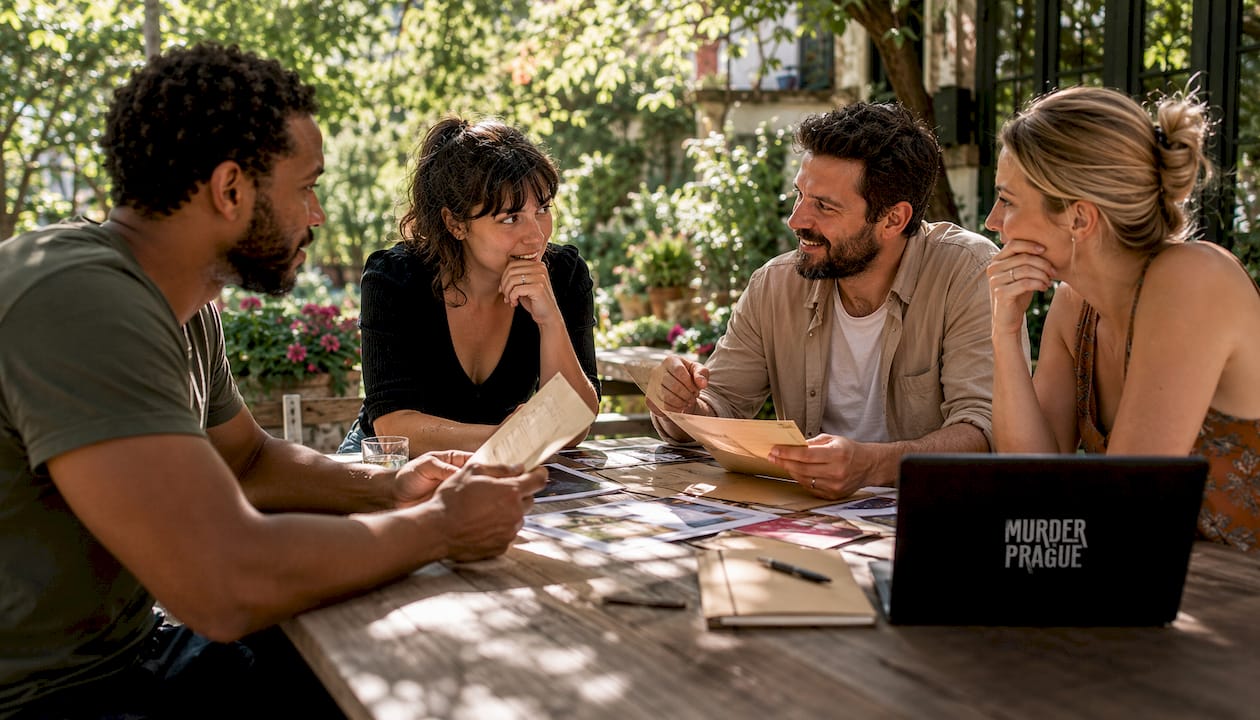
What formats deliver a cinematic murder mystery at home?
Not every format hits the same immersion level. Here's a quick menu:
- Interactive movie kits (cinematic video + physical evidence): Best for couch groups who want low host effort and high story payoff. Murder in Prague sits here.
- Hosted virtual investigations (live host + remote actors): Best for distributed groups or anyone who wants real-time interactivity with a facilitator running the scene
- Live-action role / small-scale LARP at home: Best for groups who love character immersion and don't mind prep; immersion is high but host effort is also high
- Audio/ARG formats: Best for low-tech, atmospheric nights; immersion depends heavily on sound design and participant buy-in
- Escape-room-at-home kits (puzzle-first with narrative wrapper): Best for puzzle-focused groups; escape rooms force clue-sharing and coordination under a deadline, though the story often takes a back seat to the mechanics
Pro Tip: If your group has mixed enthusiasm levels, lean toward an interactive movie kit. The cinematic format carries quieter participants without requiring them to perform.
For a deeper look at self-paced vs. hosted formats, the differences in pacing and host effort are worth reviewing before you book.
How do you choose the right cinematic mystery for your group?
Start with these four questions:
- How many people? Kits designed for 2–6 work best at home; larger groups need a format with parallel investigation tracks
- How long can you hold attention? A full cinematic investigation typically runs multiple hours; if your group needs less time, consider a shorter chapter-based format
- What's the tech comfort level? Interactive movie kits need a TV and a phone; ARG formats may require app downloads and browser navigation
- Does anyone need accessibility accommodations? Printed evidence and a seated format make cinematic kits more accessible than physical LARP or outdoor hunts
Red flags to avoid: high host effort with unclear instructions, too many parallel puzzles that fracture the group into isolated threads, and formats that require pre-reading a rulebook before the fun starts.
Built-in icebreakers and low-pressure prompts reduce social anxiety and make starting conversations easier — a well-designed investigation does this automatically through the narrative itself.
For a full breakdown of cooperative mystery formats, including how role allocation affects group dynamics, that guide covers the mechanics clearly.
Pro Tip: Avoid formats that require one person to "run" the experience like a game master. Story-first kits where the narrative drives itself free the host to investigate alongside everyone else.
Practical prep: what to set up and a sample timeline
Must-haves checklist:
- Large screen or TV with reliable streaming or disc playback
- Clear audio (external speaker makes a real difference)
- Printed physical evidence laid out on a table before guests arrive
- Pens, sticky notes, and a dedicated investigation surface
- Dim lighting and a themed soundtrack cued up for atmosphere
- Phone charged and accessible for suspect calls
Staging and sensory cues — dim lights, a soundtrack, physical props on the table — are high-leverage levers that prime immersion fast. Good note-taking habits also keep the investigation organized when clues start stacking up.
Sample evening timeline:

What does a Murder in Prague evening actually look like?
The flow runs: watch, collect, call, analyze, reveal. Here's how it feels in practice:
- Opening scenes: initial 20-30 minutes The film opens on Prague's smoky streets. You're watching a cinematic thriller with a cast that feels genuinely believable — not actors reading from a script, but characters with history. Evidence packets sit on the table, unopened.
- First evidence drop: after initial scenes The video pauses. You pick up a suspect's phone records while they're still on screen. Cross-referencing what they just said against what's in your hand — that tension is immediate.
- Suspect calls: during the middle section of the experience Your phone rings. An actual character from the film calls to give you information, or maybe misdirection. The group debates in real time.
- Deep investigation: later phase of analysis Bank records, case files, and the digital investigation app open up new threads. Quieter participants often shine here — detail-oriented analysis matters more than volume.
- Final reveal: concluding part of the experience You submit your verdict. The film resolves. Whether you got it right or not, the post-experience conversation often continues for some time.
Pro Tip: Pause the video whenever the group needs more time with a piece of evidence. The story holds — there's no penalty for taking a breath.
For a full mystery party night structure guide, including pacing advice for different group sizes, that resource covers the facilitation details well.
What does Murder in Prague cost, and where do you get it?
The pricing sits at the escape-room-immersion level for roughly a movie-ticket price per person — a fraction of what a physical escape room or hosted live event costs.
- Low end: Digital-only formats from various providers, minimal physical evidence
- Typical: Complete kits like Murder in Prague, including cinematic video, physical evidence, and investigation tools
- High end: Hosted live virtual events with real-time actors and a dedicated facilitator
Murder in Prague ships physical evidence directly to your door, with digital components available immediately on order. The detective investigation kit includes the cinematic film, authentic printed evidence, suspect call access, and the investigation app. If you want the experience tonight, the digital delivery path gets you started within minutes.
How to assign characters and encourage role-play
Not every group arrives ready to perform. The good news is that a well-written investigation doesn't require anyone to "act." Assigning roles based on personality rather than performance comfort works better: give the analytical person the financial records, the skeptic the suspect dossier, and the social connector the suspect call duties.
Encourage light role-play by framing it as a professional choice rather than a theatrical one. "You're the lead detective on this case" lands differently than "pretend you're a detective." The former feels like a job; the latter feels like a dare. Small framing shifts like this lower the barrier considerably for groups who aren't natural performers.
How to adapt when the evening goes sideways
Groups move at different speeds, and that's fine. If one thread is dominating and others are disengaging, redirect with a specific question: "What do the bank records say about the timeline?" pulls focus back to shared evidence rather than one person's theory.
If the group finishes faster than expected, the investigation app typically holds additional layers — secondary evidence threads that reward deeper analysis. Conversely, if energy dips mid-investigation, a short break with the evidence still on the table usually reignites the debate naturally. The narrative itself does most of the heavy lifting; your job as host is mostly to get out of its way.
Key Takeaways
Story-first cinematic investigations like Murder in Prague consistently produce stronger group engagement than skill-based formats because the narrative levels the playing field and drives momentum without host effort.

Why cinematic investigation design matters more than most people realize
Most group activities fail not because people don't want to engage, but because the format puts the burden of fun on the host. Someone has to manufacture energy, keep the pace, and rescue awkward silences. That's exhausting, and it shows.
What drew us to the cinematic investigation format was the opposite dynamic: the story carries the room. When the film cuts to a suspect's face and the physical evidence in your hand contradicts what they're saying, the group doesn't need prompting. The tension does the work. That's not a design accident — it's the whole point.
The experiences that linger aren't the ones where everyone performed well. They're the ones where something genuinely surprised the group, where a quiet person cracked the key clue, where the debate after the reveal ran longer than the investigation itself. That's what "excited togetherness" actually feels like in practice, and it's what a well-built cinematic investigation reliably produces.
Experience a cinematic investigation tonight with Murder in Prague
Murder in Prague delivers escape-room-level immersion without leaving your couch — at a fraction of the cost of a physical venue or hosted live event.
