


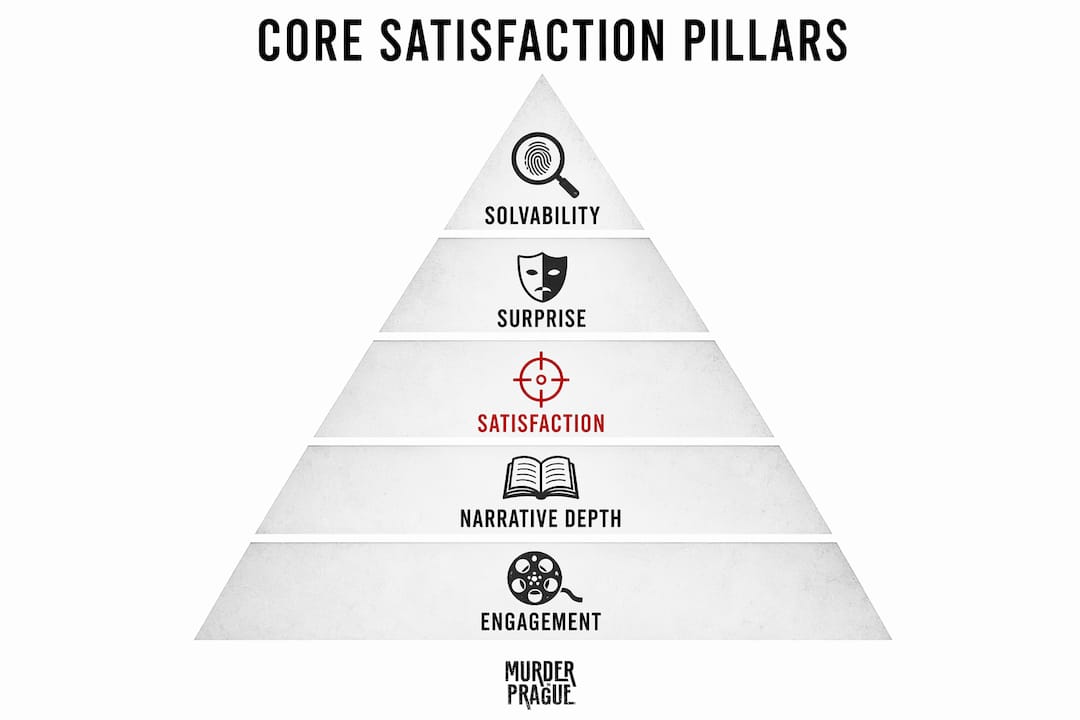
Solo mystery investigations feel satisfying because they place one person at the center of authentic detective work, with fair clues, meaningful choices, and a cinematic payoff that lands emotionally. The design elements responsible for that feeling are consistent across the best experiences:
- Solvability: every clue points somewhere real, and the truth is reachable through logic
- Surprise: a well-placed twist recontextualizes what you thought you knew
- Satisfaction: the emotional payoff when the case closes and the investigation feels earned
Mystery narrative designer Kinjo Goldbar attributes this framework to the anatomy of any great mystery. The rest of this article unpacks how each pillar works, why solo design amplifies them, and how cinematic production turns deduction into something that feels genuinely thrilling.
What are the three design pillars that make solo mysteries work?
Kinjo Goldbar's three-pillar model is a practical design checklist that balances clue density, misdirection, and narrative payoff. Each pillar does a specific job.
Solvability means the investigator has a fair path to the truth. Clues connect logically, red herrings are balanced rather than arbitrary, and a careful reader of the evidence can reach the correct conclusion without guessing. Without this, the experience feels rigged.
Surprise is the twist that recontextualizes earlier evidence. Done well, it doesn't contradict what you found; it reframes it. You realize the phone record you dismissed in chapter two was the key all along. That moment of realization is one of the most rewarding feelings in any investigative story.
Satisfaction is the emotional destination. It's the feeling that the investigation was worth the effort, that the characters were real enough to care about, and that the resolution lands with weight. Good designs withhold a single reveal mechanism to force the investigator to synthesize the evidence themselves, which makes that final moment feel owned rather than handed over.
"The best mysteries don't just surprise you at the end — they make you feel smart for getting there, and foolish for missing what was right in front of you the whole time." — Kinjo Goldbar
Murder in Prague is built around exactly this framework. Its narrative layers clues across video scenes, physical case files, and a digital app so that each pillar activates at a different stage of the investigation.
How does one-player design differ from multiplayer mystery experiences?
When a mystery is designed for a single investigator, several mechanics shift in ways that actually increase satisfaction.

Pacing control is the most significant change. In a group setting, the fastest thinker often drives conclusions, and quieter participants get pulled along. Solo, you set the tempo. You can rewatch a scene, sit with a piece of evidence, or sleep on a contradiction before returning to it. That depth of focus is hard to replicate in a group.
Branching narratives and consequences hit differently when you're alone. Wrong accusations carry real weight in well-designed solo experiences, allowing an incorrect arrest or an unresolved case to stand as the outcome. There's no one else to blame. That accountability sharpens reasoning and makes a correct conclusion feel genuinely earned.
The contrast between solo and multiplayer mechanics breaks down like this:
- Multiplayer: roleplay, social timing, group consensus, shared deduction
- Solo: evidence-first reasoning, personal consequence, methodical pacing, full ownership of conclusions
Pro Tip: If you're designing or evaluating a solo investigation for solvability, run a blind-solve trial: give a tester the full evidence set with no hints and see whether they can reach the correct conclusion through logic alone. If they can't, the clue architecture needs work.
Why do cinematic production values deepen the emotional payoff?
Production quality isn't decoration. Believable actors, location shooting, and a crafted soundtrack make narrative beats land emotionally and heighten immersion in ways that a printed case file alone cannot achieve.
Camera work shapes suspicion. A close-up held a beat too long on a suspect's expression plants doubt before any dialogue does. A score that shifts from warm strings to something colder when a new piece of evidence appears tells you something is wrong before your brain has processed why. These are cinematic tools, and they work on the solo investigator the same way they work on a film audience.
Authentic physical evidence converts passive watching into active investigation. When you're holding a printed bank statement while a character on screen denies any financial motive, the contradiction is visceral. Hybrid experiences combining video, physical files, and app-based tools best replicate investigation realism at home because every sense is engaged simultaneously.
"Holding a suspect's phone record while they look you in the eye through the screen — that's the moment the story stops being something you watch and becomes something you're inside." — Murder in Prague production notes
Murder in Prague was filmed on location in Prague with an award-winning cast, and its physical evidence kit includes documents designed to feel like genuine case materials. The soundtrack shifts with the investigation's emotional arc. Those choices aren't incidental; they're what separate a cinematic investigation from a puzzle sheet.
How do you get the most from a solo investigation experience?
The mindset matters before anything else. Treat the experience as a real investigation, not a puzzle to be solved as quickly as possible. Rushing to an accusation before the evidence supports it is the fastest way to undercut the satisfaction the design is built to deliver.
- Set your pace deliberately. Decide upfront whether you're doing this in one session or across two evenings. Both work; what doesn't work is rushing the final third because you're tired.
- Take structured notes. A timeline and evidence catalog convert scattered clues into a coherent case. Write down who was where, when, and what they claimed.
- Build a contradiction list. When a character's statement conflicts with a document, note it explicitly. Contradictions are usually where the truth lives.
- Catalog every piece of evidence before drawing conclusions. Resist the pull toward an early theory. The best investigations reward patience.
- Avoid early accusations. In experiences with consequence mechanics, a premature accusation can close off narrative branches or lock in an incorrect ending.
Pro Tip: Pause after each major scene and return to your evidence before moving forward. Evidence that seemed minor at the start of the investigation often becomes the linchpin once you know what to look for.
Which formats best satisfy solo investigators at home?
Different formats deliver different levels of immersion. Here's how the main categories compare:

Why does solving a mystery feel so good psychologically?
The emotional payoff of a solo investigation draws on several overlapping psychological drivers. Pattern recognition and hypothesis testing activate the brain's reward circuitry; each confirmed deduction releases a small hit of satisfaction that compounds as the case builds. Mastery, the feeling of becoming genuinely competent at reading evidence, deepens with each session.
Agency is the most underrated factor. Owning a correct or incorrect accusation without a group to share the outcome with creates a level of emotional investment that multiplayer rarely matches. When you get it right, it's entirely yours. When you get it wrong, the sting is real and instructive.
Curiosity closure, the relief of finally understanding something that was deliberately withheld, is one of the most powerful emotional experiences a story can deliver. Pair it with surprise and mastery, and you have the psychological engine behind every great mystery.
How do solo mystery experiences compare to other solo genres?
Solo mystery investigations occupy a specific emotional niche that most other solo genres don't reach. Puzzle experiences like crosswords or logic grids deliver pattern satisfaction but no narrative stakes. Role-playing experiences offer character investment but rarely the deductive rigor. Escape room-style challenges combine time pressure with problem-solving but often sacrifice story depth for mechanical difficulty.
What makes the solo mystery format distinct is the combination of narrative empathy and deductive agency. You care about the characters and you're responsible for the outcome. That dual engagement is what keeps the experience in your head long after the case closes.
Key Takeaways
Solo mystery investigations satisfy because they combine fair clues, earned surprises, cinematic production, and personal consequence into a single experience where the investigator owns every deduction.

The investigation that stays with you
There's a specific moment that separates a great cinematic investigation from everything else: you're holding a document, a bank record or a phone log, and the character on screen is explaining themselves with complete confidence. Then you look down at what's in your hand. The numbers don't match. The story doesn't hold. And suddenly the whole case tilts.
That moment is what Murder in Prague is built around. Filmed on location in Prague with an award-winning cast, it delivers that feeling through cinematic scenes, an original soundtrack that shifts with the investigation's emotional arc, and physical evidence designed to feel genuinely consequential. The production is film-level. The stakes are real. And the cost is closer to a movie ticket than an escape room booking.
Experience a cinematic investigation at home with Murder in Prague
If the design principles in this article describe exactly what you've been looking for, Murder in Prague is where they come together. This isn't a board experience or a printed puzzle sheet. It's a cinematic murder-mystery investigation where you watch the story unfold on screen, receive calls from suspects, and hold the physical evidence that either confirms or destroys their alibi.

The branching consequence mechanics mean your accusation matters. The film-quality production means the characters feel real. And the physical evidence kit means you're never just watching. You're investigating. Start your investigation at the Murder in Prague detective kit page and find out whether you can close the case.
Recommended
-
What Is a Self-Paced Murder Mystery Experience? Your Full Guide – Murder in Prague
-
What Is a Self-Paced Mystery Game? Your Full Guide – Murder in Prague
-
Murder Mystery Kit with Cinematic Video - Delivered (Murder in Prague)
-
Surviving a Double Date: Why an Interactive Murder Mystery is the Ulti – Murder in Prague