

Four changes make the biggest difference when you want to enhance atmosphere in a solo mystery investigation: controlled low-key lighting, silence-first sound design, staged tactile clues, and discovery-driven pacing. Apply all four before you start, and a living room transforms into something that genuinely unsettles you. Each lever works because it hands the imaginative work back to you, the solo investigator, rather than spelling everything out.
For anyone who wants all of this built in from the start, Murder in Prague delivers a fully cinematic solo investigation with filmed-on-location video, realistic physical evidence, and an app that calls you from suspects mid-scene.
What can you do in 30 minutes to set the scene?
- 0–5 min: Lighting. Dim overhead lights to roughly 20–30% or switch them off entirely. Place one lamp at roughly 180–300° behind and to the side of your seat. The goal is a single, slightly uncomfortable pool of light.
- 5–10 min: Sound and phone. Enable Do Not Disturb on your phone, whitelist only the investigation app, and queue your ambient soundtrack on an external speaker at low volume.
- 10–20 min: Arrange three tactile clues. Place sealed evidence envelopes, phone records, and any physical props at three distinct spots around your space, not all on one table.
- 20–25 min: App and video check. Log into the companion app, confirm audio sync between TV and speaker, and run a 30-second test clip to catch any lag.
- 25–30 min: Final immersion check. Silence household notifications, dim your phone screen, and do a slow visual sweep of the room. If something looks too ordinary, move it or cover it.
If you hit an audio delay between TV and speaker, switch the TV audio output to PCM and reduce Bluetooth latency by moving the speaker within six feet of the TV. App login issues almost always resolve with a force-quit and relaunch before play begins.
How do lighting, sound, and scent shape the feel of a solo investigation?
Partial darkness is more effective than total darkness. A single directional lamp creates one "motive shadow," and your eye keeps returning to whatever sits just outside that light. That involuntary attention is curiosity doing its job.

Sound design should start with silence and build outward. A recommended ambient mix runs roughly 70% ambient tone and foley, 20% subliminal underscore, and 10% music used only for punctuation. Playing a soundtrack at full volume from the first second kills the effect; the absence of expected sounds is what creates unease.
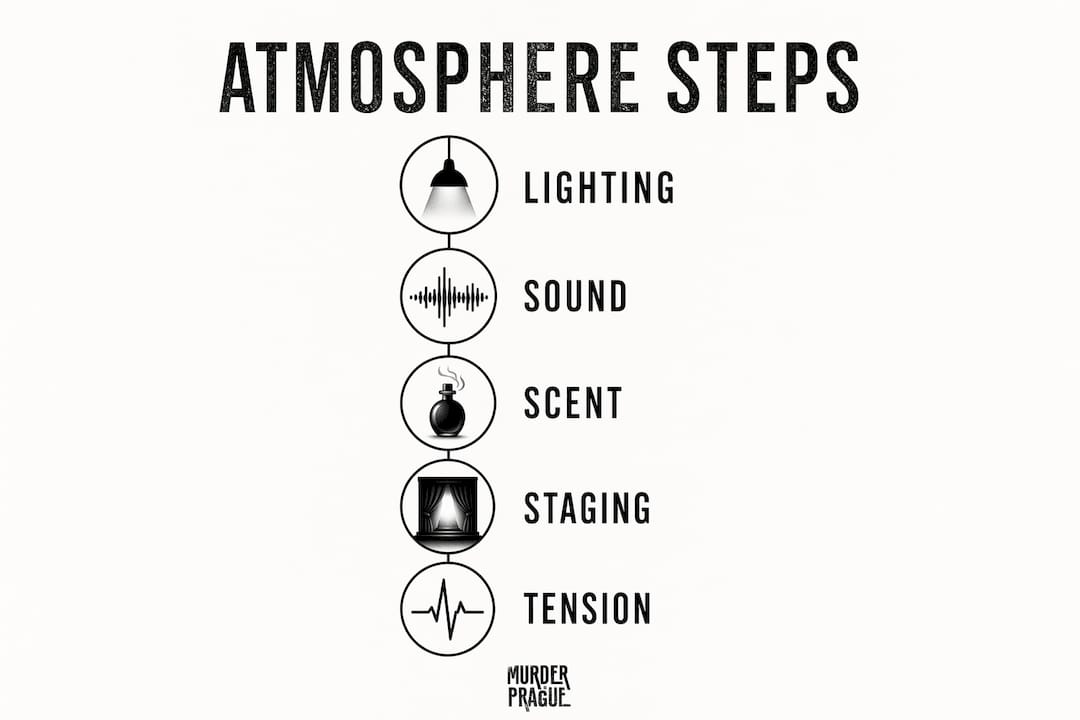
Scent is optional but surprisingly effective. A single low-burn candle with a woody or smoky note anchors the sensory environment without demanding attention. Arrange your three anchor props so you physically re-encounter them at different points in the session, not just at the start.

Pro Tip: Highlight exactly one oddity with light. If you illuminate every prop, nothing feels strange. Pick the single most suspicious object and let the lamp fall on it naturally.
How do you hint at a story rather than explain it?
Environmental storytelling works on a simple rule: show small, consistent inconsistencies instead of stating backstory. Designers describe this as the "wrongness" of place, the feeling that something happened here that no one has acknowledged.
Six quick staging ideas:
- A clock stopped at an odd time, not midnight, but 2:17 PM
- A photograph in a frame that is slightly too large for the image
- A coffee cup on the wrong side of a desk for a right-handed person
- An open book with a passage underlined and then crossed out
- A chair pulled back from a table at an angle that suggests someone left in a hurry
- Two receipts from the same day, hours apart, from cities that are not close
What to avoid: redundant labels ("this is suspicious"), too many red herrings that lead nowhere, and any prop that requires reading a paragraph of context to understand. If a detail needs explanation, it is not doing its job.
How do you build tension that works for one player?
Discovery pressure is the most effective tension tool for solo play. Each new piece of evidence should answer one question and immediately raise a more urgent one. Urgency grows from understanding, not from a countdown clock.
A workable session rhythm looks like this:
Opening normalcy (0–15 min): Establish the scene. First-tier clues are accessible and relatively clear. The player feels competent.
Small violation (15–25 min): A second-tier clue contradicts something from the first. Certainty vanishes.
Reflective pause (25–30 min): No new evidence. The player sits with the contradiction. This is where imagination does the heavy lifting.
Escalation (30–50 min): Third-tier clues arrive, and at least one is deliberately delayed to destabilize earlier theories.
Forcing function (50–60 min): A permanent choice. Accuse someone, and the narrative shifts in a way that cannot be undone.
Permanent consequences raise perceived stakes dramatically. If a wrong accusation means another character acts independently, or a piece of evidence disappears, the solo player treats every decision as real. That weight is what separates a memorable investigation from a puzzle you solved and forgot.
What tech setup keeps a solo investigation cinematic?
The single best workflow: TV handles video playback, an external Bluetooth speaker handles ambient audio, and your phone runs the companion app with all other notifications silenced.
Concrete steps:
- Set TV audio output to PCM to avoid processing delays.
- Place the Bluetooth speaker within six feet of the TV and at ear height.
- Open the companion app and confirm your account is logged in before dimming the lights.
- Set your phone to Do Not Disturb with only the app whitelisted for calls and notifications.
- Run a 60-second test of video plus ambient audio together to confirm sync.
Common issues: audio lag (fix with PCM output and shorter Bluetooth distance), app notifications blocked (check app notification permissions in phone settings), and login timeouts (keep the app open in the foreground throughout play).
Pro Tip: Wear a watch instead of checking your phone for the time. Glancing at a phone screen, even briefly, pulls you out of role faster than almost anything else.
How should you stage physical clues for one player?
Physical evidence works best when it has weight, texture, and a reason to be handled. Sealed envelopes feel different from loose papers. Phone screenshots feel more like real records than glossy photo paper. A small, heavy prop, a key, a coin, a folded receipt, communicates authenticity before you even read it.
High-impact, low-cost materials:
- Sealed envelopes with wax or tape closures (prevents accidental early reveals)
- Phone records or bank statements on aged or matte paper
- Handwritten notes with deliberate inconsistencies in the handwriting
- A single small physical object (key, ticket stub, business card)
Staging rules: one oddity per encounter, not three. Sequence evidence so each item points toward the next. Use a note-taking system to track what each clue implies, because a solo player has no partner to remember details aloud. Mark discovery order on the back of each envelope in pencil so you do not accidentally open them out of sequence.
Pro Tip: Evidence on 24 lb paper rather than standard 20 lb copy stock. The extra weight makes a document feel like a real record rather than a printout.
What solo logistics should you plan before you start?
Ideal session length for a solo investigation is 60–90 minutes with one built-in reflective pause around the midpoint. Longer than 90 minutes without a break tends to flatten tension rather than build it.
For privacy: close the door, put a simple "do not disturb" signal outside if you share a space, and set your phone to Do Not Disturb before you sit down. If you are interrupted mid-session, pause the video, place a physical marker on your current clue, and step away. The investigation resumes cleanly when you return.
Emotionally intense content deserves a moment of preparation. If a scene covers themes you find difficult, keep a neutral show queued on a second device as a quick reset. Knowing the exit exists makes it easier to stay in the investigation.
Pro Tip: Tell one person you trust that you are doing a solo investigation session and roughly when you expect to finish. It is a light check-in that costs nothing and adds a small layer of real-world grounding for intense scenes.
Why does cinematic production quality change a solo investigation?
Cinematic production, realistic physical evidence, and an integrated app share that load. When an actor speaks on screen and you are holding that character's phone records in your hands, the story stops being abstract.
Murder in Prague is filmed on location in Prague with an award-winning cast, and the physical evidence box contains realistic case files, phone records, and tactile props that match what you see on screen. The companion app delivers in-character phone calls and texts timed to the investigation, so the story reaches into the room rather than staying on the TV.
That integration is what makes a solo session feel consequential rather than solitary.

